Age-friendly Cities and Communities: Connecting the WHO Vision with Local Realities (AFCC)
This project investigates age-friendly urban development in Afghanistan, Bangladesh, India, and Iran. Through stakeholder perspectives, it develops a context-sensitive understanding of ageing, governance, participation, and urban inclusion across diverse socio-political, cultural and economic contexts.
Description
The WHO Age-Friendly Cities and Communities (AFCC) framework is the leading global vision for adapting cities to demographic ageing. Yet research shows that it still carries significant biases: it is shaped mainly by European and North American experiences, pays limited attention to poverty, inequality, and fragile governance, and often remains disconnected from the realities of older adults in non-Western settings.
Our project responds to these gaps by generating a context-sensitive analysis of age-friendly urban development in selected cities across Afghanistan, Bangladesh, India, and Iran. It examines how socio-spatial environments affect older adults, drawing on insights from actors who work directly with them (local administrations, NGOs, community organisations, planners, social work professionals). By analysing how these intermediaries perceive needs, barriers, and opportunities, the project explores how the AFCC concept can be meaningfully adapted to diverse cultural, political, and economic contexts.
The project has three goals:
- to develop a knowledge base on age-friendliness in the participating countries;
- to understand how governance structures, stakeholder constellations, and participatory practices influence the emergence of age-friendly environments; and
- to synthesise these insights into a context-sensitive and socially inclusive interpretation of AFCC.
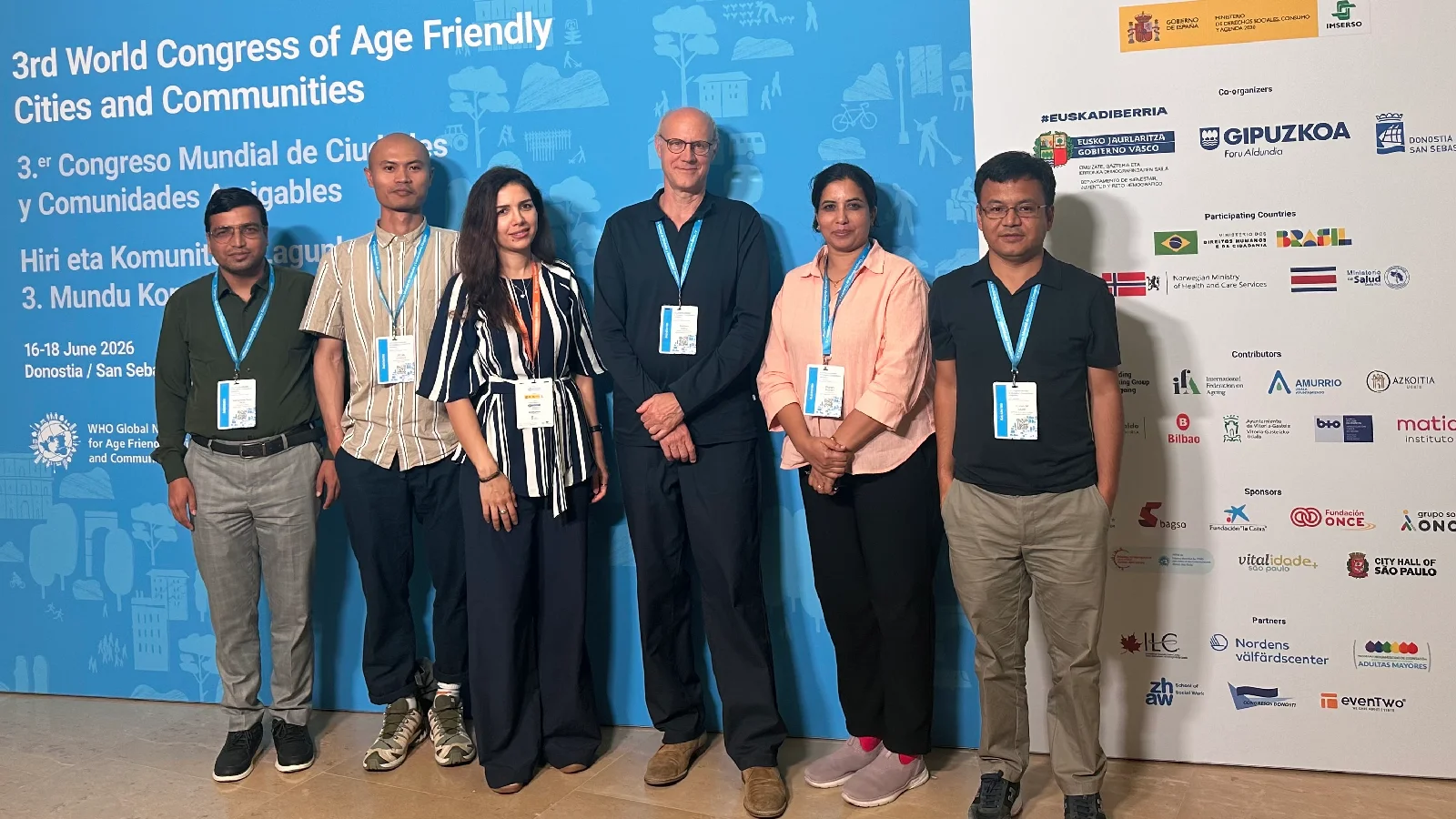
The consortium will prepare shared outputs for the 2026 WHO 3rd AFCC World Congress in San Sebastián. The project produces country reports, a WHO-oriented synthesis report, scientific publications, academic networks, local workshops, and stakeholder briefings.
Key data
Projectlead
Deputy Projectlead
Anna Fatima Salomoni (University of Galway)
Co-Projectlead
Dr. Safoora Mokhtarzade (Daneshpajoohan Pishro Higher Education Institute), Maryam Taefni (Daneshpajoohan Pishro Higher Education Institute), Dr. Mohammad Nurul Amin (Port City International University), Coxy Talukder (ASHIKA Development Associates), Mohammad O. Hisham (Kabul University), Dr. Sayed S. Muzafary (Kabul University), Prof. Bharathi Bharathi (Christ University)
Project team
Arjan Chakma (Port City International University), Dipta Chakma (Port City International University), Dr. Rustam Ali Seerat (Kabul University), Ramin Sultani (Kabul University), Sayed B. Basaam (Kabul University), Dr. Emmanuel Daniel (Christ University), Ida Merlin (Christ University), Goodwin Jose (Christ University)
Project partners
Daneshpajoohan Pishro Higher Education Institute; Port City International University; ASHIKA Development Associates; Kabul University; Christ University; University of Galway
Project status
ongoing, started 06/2026
Institute/Centre
Institute of Diversity and Social Integration (IVGT)
Funding partner
EU and other international programmes
Project budget
35'000 CHF
School of Social Work
Pfingstweidstrasse 96
8037 Zürich