Immediate Support for School Stress: A Digital Feedback System for Adolescents Immediate help with school stress. A Digital feedback system for adolescents
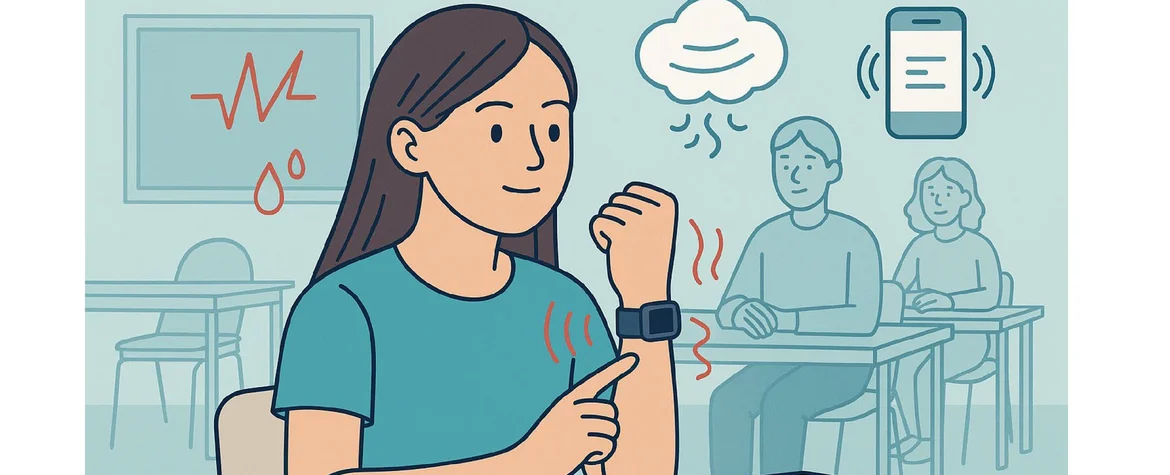
The study explores how adolescents perceive and accept wearable stress sensors in everyday school life. It examines usability, subjective stress reporting, and attitudes toward personalized digital feedback, offering insights into youth‑friendly, privacy‑aware stress‑regulation tools.
Result
Acceptance & usability (survey + interviews):
- Most students perceived the sensor as unobtrusive;
- ~70% reported no interference with lessons.
- 80% noticed sensors on peers, but this was usually not disturbing.
- Students quickly adapted to wearing the device, though size, weight, and electrodes were criticized.
- No major disruptions or social conflicts observed; smooth integration into lessons.
Subjective stress perception (survey):
- The stress scale was considered simple and helpful.
- The double-tap function to mark subjective stress was widely used and perceived as a reflective tool.
Breathing exercise (survey):
- Only a few students tried the optional 7–8–9 method, but those who did often reported in the survey feeling calmer afterwards.
Experiences & attitudes (interviews):
- Overall positive attitude, marked by curiosity and self-observation.
- Students were open to personalized feedback systems (e.g., breathing prompts, micro-exercises, haptic vibration).
Improvement suggestions (survey + interviews):
- Requests for smaller, lighter, less visible devices.
- Desire for more discreet and comfortable sensor design.
Concerns - data privacy (interviews):
- Adolescents expressed strong concerns about data security.
- Majority accepted potential teacher access if used for support, not evaluation.
Description
Adolescents increasingly experience school‑related stress, yet little is known about how they perceive digital tools designed to support real‑time stress regulation. This project addresses this gap by exploring the acceptance, experiences, and concerns of young people regarding wearable stress sensors and personalized feedback systems in everyday school life.
The study used an exploratory mixed‑methods design and was conducted in two secondary school classes in German‑speaking Switzerland in May 2025. A total of 25 adolescents (aged 12–15) participated voluntarily with parental consent; 22 completed the wearable stress monitoring and 18 took part in short semi‑structured interviews.
The procedure included several components:
- Physiological stress monitoring: Students wore EDA sensors during regular lessons, excluding physical education and practical subjects.
- Surveys: After each lesson, short online questionnaires (Unipark) assessed stress perception, lesson experience, and acceptance. At the end of the school day, students completed a longer final survey.
- Optional stress‑reduction exercise: When reporting stress, participants could perform a brief 7‑8‑9 breathing technique.
- Interviews: Semi‑structured interviews (4–6 minutes) focused on experiences with the device, acceptance, concerns, and suggestions for improvement.
The project aims to integrate subjective and physiological stress indicators, evaluate usability and youth acceptance, and explore the potential of low‑threshold, personalized digital feedback to support stress awareness and self‑regulation in school settings.
In addition to the project team listed below, Anthony Klein Swormink, research assistant at ZHAW, contributed to the project.
Key data
Projectlead
Project team
Dr. Clara Weber, Dominik Kunz, Dominique Truninger, Prof. Dr. Frank Wieber
Project partners
University Of Surrey; Universität Konstanz
Project status
completed, 02/2024 - 12/2024
Institute/Centre
Institute of Facility Management (IFM); Institute of Public Health (IPH); Institute of Computational Life Sciences (ICLS)
Funding partner
ZHAW digital / Digital Futures Fund for Research & Development (DFF for R&D)
Project budget
20'000 CHF
Further documents and links

School of Life Sciences and Facility Management
Reidbach
8820 Wädenswil