Beyond Grey Walls: A Living Lab Unveiling the Benefits of Biophilic Design in University Classrooms
In this project, an existing university classroom is transformed into a so-called “Green Classroom” through a participatory design process. The focus is on integrating biophilic design elements in order to positively influence well-being, attention, and the perception of learning spaces.
Result
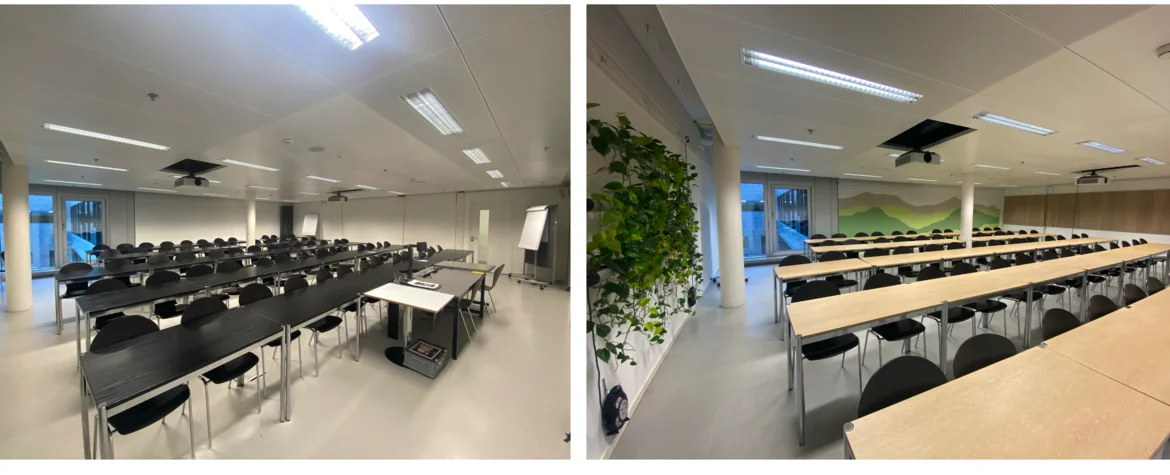
The results show that in the Green Classroom, both participants’ well-being and their attention control developed positively. In addition, the perceived quality of the room was rated much more positively than before. These changes did not occur in the conventional “Grey Classroom.”
This underlines the potential of biophilic design as a modular, low-threshold approach to upgrading educational spaces that can support both well-being and cognitive performance. At the same time, the project provides empirical evidence for the effects of integrating nature into learning environments and demonstrates a participatory, transferable model for transforming existing classrooms.
Description
Learning environments shape not only students’ daily academic experience but also their well-being and performance. Nevertheless, many university classrooms are designed in a purely functional and rather austere way, containing few or no natural elements. This project addresses this gap by examining how the integration of nature into learning environments can influence students’ experience and attention.
Building on insights from environmental and design research, the project follows a biophilic design approach that emphasizes natural materials, greenery, and improved room acoustics. The aim is to transform an existing, rather plain classroom into a so-called “Green Classroom” and to use it as a living lab for teaching and research.
The redesign is carried out in a participatory process together with students, staff, and facility management. In co-design workshops, spatial concepts are developed and translated into prototypes that serve as the basis for implementation. In this way, a learning space is created that is not only functional, but also atmospheric and user-centered.
At the core of the project is the question of how such a learning environment affects well-being, attention, and the perception of room quality. To this end, the newly designed Green Classroom is compared with a conventional “Grey Classroom” in order to make differences in experience and use of the spaces visible.
Key data
Projectlead
Deputy Projectlead
Project team
Project status
completed, 02/2025 - 02/2026
Institute/Centre
Institute of Human Behaviour, Society and Technology (IMGT); Institute of Facility Management (IFM); Institute of Applied Psychology (IAP)
Funding partner
ZHAW Sustainable Impact Program

School of Applied Psychology
Pfingstweidstrasse 96
8037 Zürich