The mechanobiology of fibroblasts in soft nanofibrous materials – novel test protocols for in-situ mechanical testing
Description
Background
Mechanobiology is the study of the influence of mechanical loads on the behavior of cells, especially on their differentiation, proliferation, morphology, or metabolic activity. It determines the interaction of implants with the body and ultimately, its integration by tissue growth and remodeling. Moreover, mechanobiology determines how cells and tissues evolve due to changed physiological conditions or disease and react to surgical interventions.
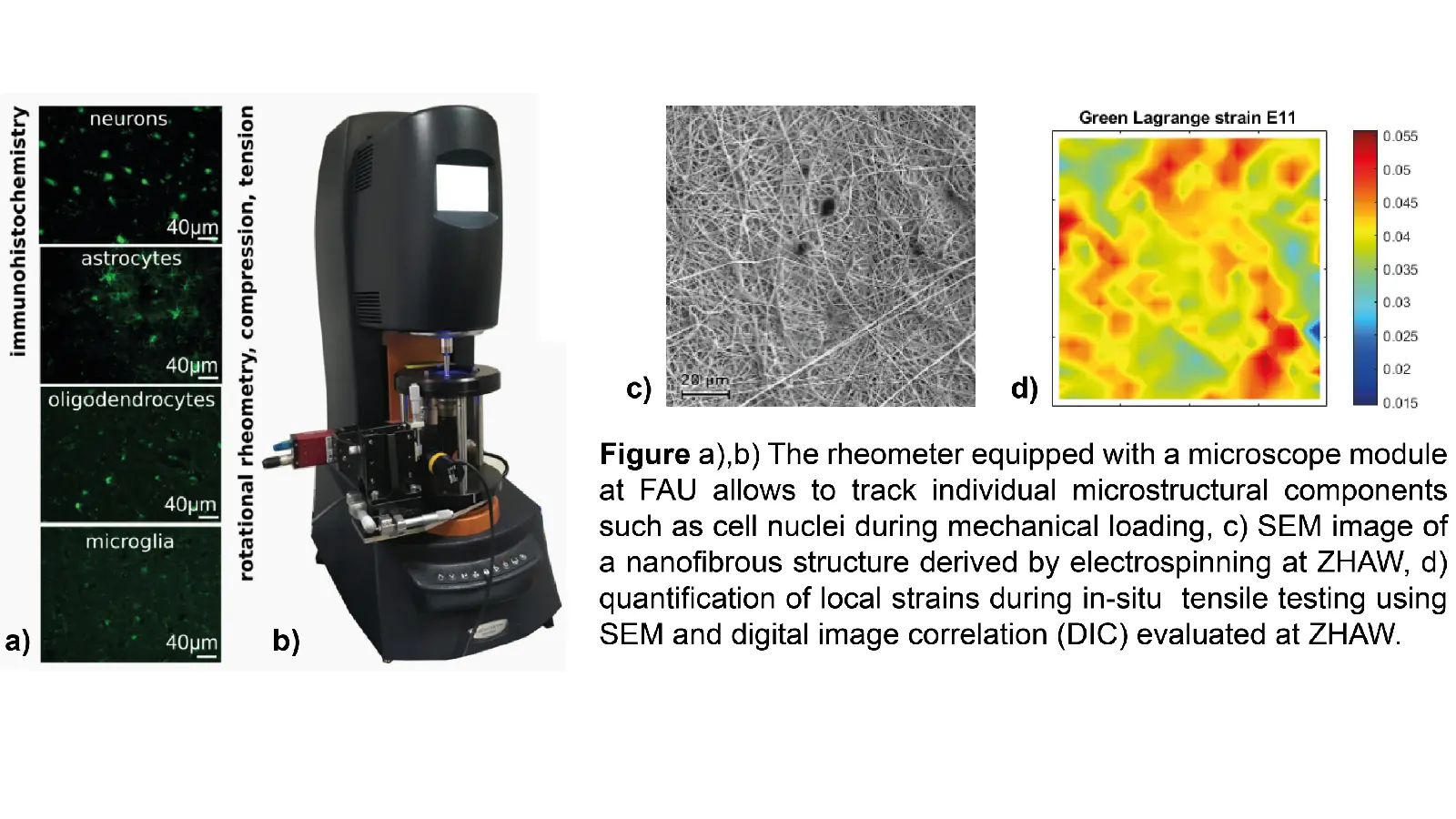
The mechanical aspect in mechanobiology comprises the transfer of loads and deformation across the hierarchical structure of biological tissues from the macroscale down to the length scale of the cells. It leads to tissue specific phenomena described as attenuation or amplification of stress and strain, resulting in a different cell response. To quantify these mechanical phenomena, test setups and protocols for in-situ testing are required. These allow for load application in combination with imaging to visualize and quantify local deformations of the tissue / material microstructure and even of the embedded cells.
Aim
The proposed project aims at protocols and first insights on the deformation behavior of cells (fibroblasts) in nanofibrous materials using a novel in-situ mechanical test setup at FAU. This setup comprises a rheometer equipped with a microscope module and is combined with a multiphoton microscope. This imaging technique allows for high resolution visualization of tissue microstructures and cells during mechanical loading.
The goals of this study are
- to develop an experimental protocol for in-situ mechanical tests using the novel setup; in particular, nanofibrous materials seeded with fibroblasts shall be tested and visualized in different loading conditions (methodological goal)
- to quantify the transfer of strains from the macroscale down to the level of cells and to correlate the kinematics of the microstructure and cells with the instantaneous cell response (technical goal).
Key data
Projectlead
Co-Projectlead
Prof. Dr. Silvia Budday (Friedrich-Alexander-Universität Erlangen-Nürnberg)
Project team
Jonas Hofmann
Project partners
Friedrich-Alexander-Universität Erlangen-Nürnberg
Project status
completed, 01/2025 - 11/2025
Institute/Centre
Institute of Mechanical Systems (IMES)
Funding partner
Interne Förderung / EELISA Projekt
Project budget
34'820 CHF

School of Engineering
Technikumstrasse 71
8400 Winterthur