Brain Research International Data Governance & Exchange – Phase II
Description
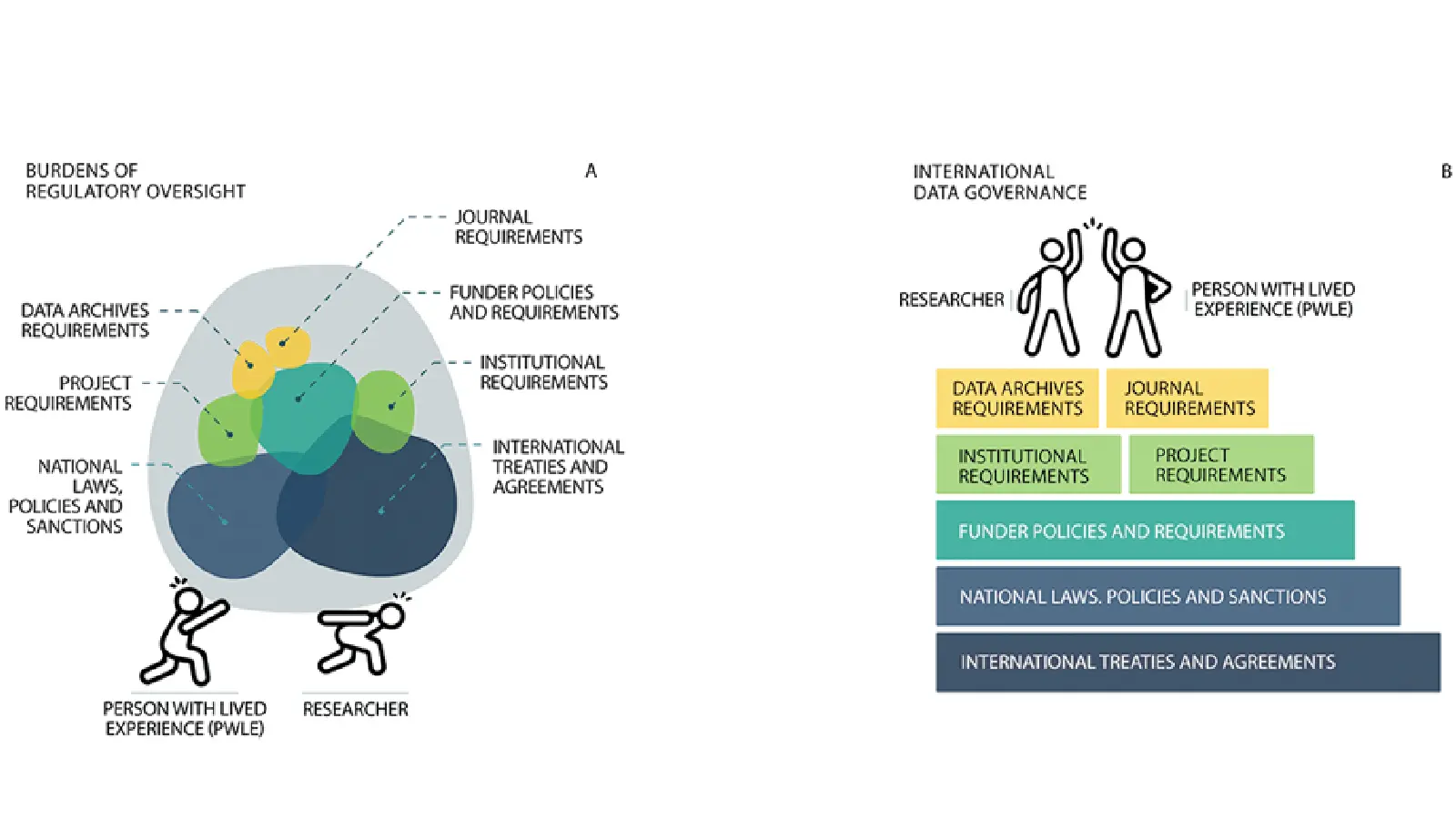
The goal of this project is to develop an International Data Governance Framework (IDGF) that can advance responsible international brain research and innovation. This will start with the identification of the technical, legal, ethical and organizational challenges to IDGF and the development of pathways to address these challenges. An effective IDGF would provide clarity and direction for individual researchers, institutions, funders and industry stakeholders as they plan large-scale programs that cross international borders.
A major outcome of the project is a collection of laws and regulations, as well as a summary of actionable methods for data sharing in various countries. The project will lay the ground for a global network for International Data Governance for Mental Health. This network will provide services and support data sharing with technology and human infrastructure to multiple stakeholders including academic and industry researchers, policy makers, and funders.

Key data
Co-Projectlead
Dr. Ricardo Chavarriaga, Prof. Dr. Damian Eke (University of Nottingham), Prof. Dr. Franco Pestilli (The University of Texas at Austin), Prof. Dr. Amadi Ihunwo (University of the Witwatersrand), Prof. Dr. Thomas Nichols (University of Oxford), Prof. Dr. Fernanda Tovar (D’Or Institute for Research and Education (IDOR))
Project team
Dr. Kimberly Ray (The University of Texas at Austin), Dr. Thais Montero (D’Or Institute for Research and Education (IDOR))
Project partners
The University of Texas at Austin; University of the Witwatersrand; University of Oxford; D’Or Institute for Research and Education (IDOR); University of Nottingham
Project status
completed, 04/2024 - 04/2025
Institute/Centre
Centre for Artificial Intelligence (CAI)
Funding partner
Foundation
Project budget
30'029 USD
Further documents and links
Publications
-
Reconciling global collaboration and data sovereignty in neuroscience
2026 Ray, Kimberly L.; Botes, Marietjie; Collier, Melanie; Yi, Alden; Hershman, Steven G.; Monteiro, Thais; Genuino, Mariana; Poline, Jean‐Baptiste; Eke, Damian; Chavarriaga, Ricardo; Ihunwo, Amadi Ogonda; Tovar-Moll, Fernanda; Nichols, Thomas E.; Pestilli, Franco
-
Decoloniality impact assessment for AI
2025 Eke, Damian; Chavarriaga, Ricardo; Stahl, Bernd
-
The NERVE-ML (neural engineering reproducibility and validity essentials for machine learning) checklist : ensuring machine learning advances neural engineering
2025 Carlson, David Edwin; Chavarriaga, Ricardo; Liu, Yiling; Lotte, Fabien; Lu, Bao-Liang
School of Engineering
Technikumstrasse 71
8400 Winterthur