Shaping AI responsibly
Artificial intelligence is changing the way we work, communicate and make decisions. Yet AI is not inherently reliable, fair or safe. At the ZHAW School of Engineering, it is therefore important to consider how ethical, social and legal requirements can be integrated into the development and use of AI from the outset.
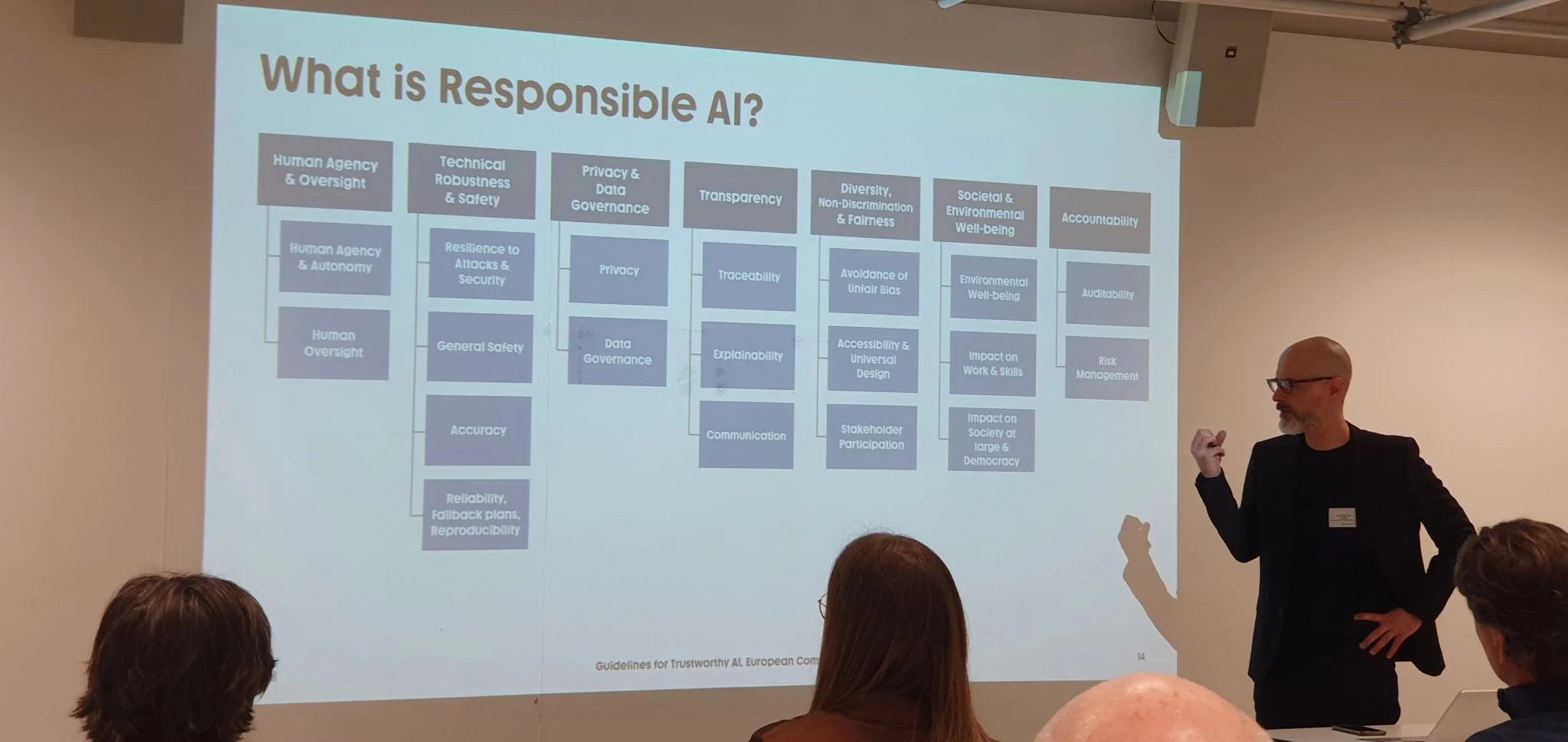
AI is now used in almost every area of life. It analyses data, automates processes, creates content and supports decision-making. At the same time, however, it can exhibit unintended behaviour: false information, manipulation, discrimination, inexplicable or non-transparent actions, and risks to users or others affected – to name just a few examples. Preventing this requires AI not only to perform a task as well as possible, but also to be designed responsibly across all relevant dimensions – a key focus of research and work in artificial intelligence at the ZHAW School of Engineering.
Taking a wide range of factors into account
Responsible AI is considered from several perspectives and needs to be addressed before harm occurs. The aim is to identify potential negative consequences for people, society or the environment at an early stage and to embed responsibility throughout the entire development process. This requires taking into account the interplay between technology, data, business models and the broader societal context.
Relevant questions include how to avoid incorrect or harmful decisions, the potential impact of recommendation algorithms on political discourse, environmental effects such as the energy consumption of data centres, and issues relating to discrimination and fairness. Transparency, data protection and resilience against disruption and misuse are also key aspects of Responsible AI. Developing AI responsibly therefore requires appropriate technical design – and the expertise to implement it.
“We want to ensure that future AI-based systems are designed responsibly and holistically, rather than being trained solely to perform a specific task.”
Christoph Heitz, Head of AI & Society at the Institute of Data Science (IDS)
At the ZHAW School of Engineering, research groups at the Centre for Artificial Intelligence (CAI), led by Ricardo Chavarriaga, and at the Institute of Data Science (IDS), led by Christoph Heitz, are particularly active in the field of Responsible AI. Responsible AI is also already integrated into teaching. The Bachelor’s degree programmes in Computer Science and Data Science offer an elective course on the topic, while relevant skills and expertise are also taught in various continuing education programmes.
A point of contact for Responsible AI questions
To promote and institutionalise expertise in Responsible AI, the ZHAW School of Engineering plays a leading role in the Swiss Centre for Responsible AI (SCRAI). The competence centre supports companies and public administrations in designing and using AI responsibly, with the aim of making Responsible AI a lived reality in Switzerland. The think-and-do tank was established with funding from the DIZH and has recently become an independent association.
Several higher education institutions from the Zurich area are involved. The ZHAW School of Engineering contributes the technical perspective, while the University of Zurich provides legal expertise. The Zurich University of Teacher Education focuses on the attitudes of employees and teams as well as team dynamics in the use of AI within organisations. Zurich University of the Arts complements these perspectives with societal, design-oriented and user-centred approaches. This multi-perspective approach is crucial.
SCRAI aims not only to conduct research into Responsible AI, but also to develop practical solutions for companies and public institutions. It supports organisations in establishing AI strategies, governance structures and processes.
“The need is considerable. Banks, insurance companies, platform providers and public-sector organisations are increasingly using AI, but they face many questions across the different dimensions of Responsible AI,” says Christoph Heitz. “SCRAI brings together scientific expertise and implementation know-how, makes this knowledge available to organisations and organises events to connect stakeholders across Switzerland.”
Clear requirements at European level
A look at Europe also highlights the growing importance of Responsible AI. The EU AI Act has been adopted by the European Parliament and is gradually becoming legally binding. However, many of its requirements still need to be translated into more specific technical standards. Companies need clear guidance on how to implement these requirements and demonstrate compliance. The development of these standards has been entrusted to CEN-CENELEC and its JTC 21 ‘Artificial Intelligence’ committee.
Around 100 representatives of this committee from across Europe will meet at the ZHAW School of Engineering in Winterthur in October for JTC 21’s annual plenary meeting, where they will continue working on the development of these standards. Christoph Heitz is also involved as a member of the Swiss working group:
“This event is a very good thematic fit for us. The standards are intended to put into practice exactly what we aim to achieve through our research and SCRAI.”