Higher Education: open and digital?
Open Education, e-learning platforms, and micro-credentials: Are these three concepts lastingly changing the way we learn, teach and view educational processes? Barbara Class (University of Geneva), Kathy Pugh (2U/edX) and Christoph Negri (ZHAW) share their insights.
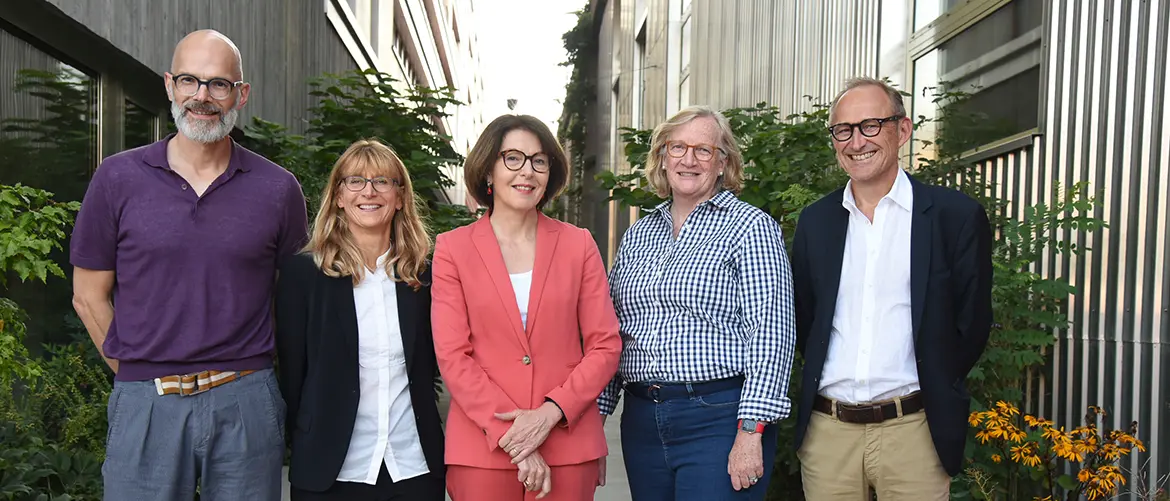
The event Open, Micro, digital Platforms – Hype or the Future of Higher Education? (see recording below) explored the impact of micro-credentials and e-learning platforms on teaching and learning in the context of Open Education. A high-calibre panel, consisting of educational researcher and lecturer at the University of Geneva Barbara Class, Sr. Vice President 2U/edX Kathy Pugh and head of ZHAW-IAP and psychologist Christoph Negri shed light on the interrelationships and possible implications for higher education institutions. The question was whether the currently much-discussed concepts and formats can actually make education more accessible, flexible and collaborative in the future.
“Openness is an opportunity for us to rethink our practice”, said Barbara Class. She has integrated the three concepts in the following manner: When discussing Open Education as a philosophy, the learning dispositives [a broader definition of digital platforms that considers both the social and technical aspects] serve as the means to make teaching and learning possible, whereas micro-credentials are the means to certify knowledge and competences (29:20)
From Authority Badges to Monstrous Hybrids
In her keynote, Barbara Class provided us with historical and theoretical background. For instance, she showed how the concept of micro-credentials draws back to Roman military badges. She also pointed out how Openness has two philosophical underpinnings: one where “open” signifies shared, common good (Middle Ages), and the other where “open” refers to a legal right (20th and 21st century).
Furthermore, Barbara examined the paradigm that currently shapes our practices. She introduced a framework (Jane Jacob’s moral syndromes) involving two sets of patterns, each associated with different values: commercial (trading/collaboration) and guardian (force/hierarchy). When these two sets of values are mixed, a “monstrous hybrid” emerges. For example, an institution that engages in trading while also receiving special privileges from the state, thus taking advantage of a value from the guardian syndrome whereas it should not and should specifically shun force.
During the discussion, a palpable tension emerged between democratic, free, open education and business models in education. The panelists shared a positive perspective on Open education as a democratized access to knowledge and explored various topics related to Open Education:
- Economic pressure (39:20)
- Benefits for students (43:00)
- Digital divide, access (54:10)
- Social interaction, cultural context (1:00:08)
- Democratization (1:02:03)
- Big Tech Companies and risks for universities (1:03:14)
- New roles of universities in the future (1:11:04)
The panel also answered questions from the interested audience:
- How would you envision us in 10 years? (1:16:40)
- How does the framework (trading, force, monstrous hybrid) help us in solving real-world problems? (1:21:25)
- What could be accessible and stackable solutions? (1:24:50)
- What can universities do better than companies? (1:31:40)
Additional information
- Introduction by Patrick Hunger (PDF 206 kB)
- Presentation slides from the keynote by Barbara Class (PDF 611 kB)
- Education Portfolio of the Strategic Initiative “ZHAW digital”
- Blog of the Department of Education: Lehren und Lernen, blogs on Open Education, Open Digital Badges, Life Long Learning etc.
- Blog of ZHAW digital: Digital Futures Lab - Community Blog
- Open Educational Resources (OER), OER team of the University library
- Center for Innovative Teaching and Learning
- ZHAW online courses on the e-learning platforms edX und Swiss MOOC Service
- LeLa LernLabor - Hochschuldidaktik
- Continuing education courses at the ZHAW
ZHAW services and resources