Cyber-Physical Immersive Learning Spaces
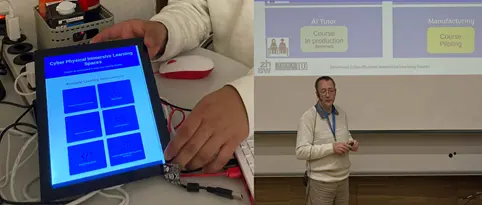
Thanks to a recently concluded Research Partnership Grant of the Leading House South Asia and Iran, researchers at the ZHAW Institute of Computer Science (InIT) have been able to design, validate and present a novel cyber-physical learning technology dubbed CPILS in an international context. Ranjan Ojha, Atik Santellán and Josef Spillner were involved on the Swiss side.
CPILS allows students to learn by interacting with the real world and with digital environments through sensors, headsets, mobile phones and autonomous computing units. These units do not necessarily depend on external supply of electricity, network connectivity or cloud services thanks to the possible attachment of solar panels, WiFi access points and an internal Kubernetes-based service delivery. A dual learning approach improves skills in domain subjects such as food health impact, waste separation or sustainable textiles but also in the underlying technologies such as computer vision, large language models and cloud/edge application development, leading to broader ICT skills in the target population. The system excels by its resource efficiency, unloading software applications from the internal Kubernetes cluster when they are not used anymore.
CPILS was presented at the Academic Development Conference 2025 in Austria, an event discussing future curriculum development that involved more than 30 universities. Over the next months, it will be increasingly used in our teaching, underlining the shift from conveying knowledge to hands-on skills while stressing the digital souvereignty of our educational technology.