Calculation of Collision Risks between Aircraft
Over the course of the last two years, a team of specialists at the Centre for Aviation has developed method to determine collision risks between aircraft in airspaces around airports. The project, which was funded by the Federal Office of Civil Aviation, has been successfully completed in August 2020.
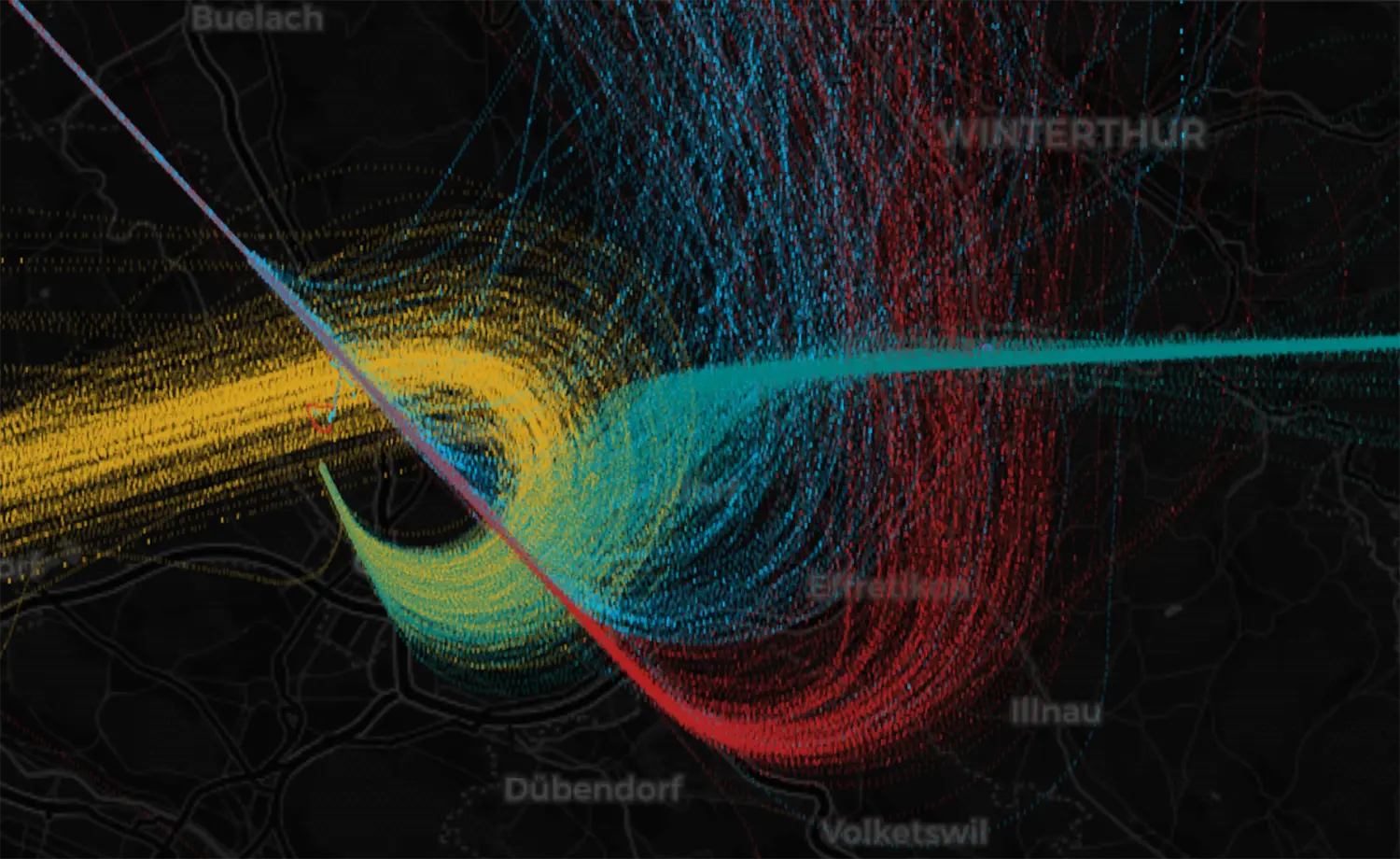
Over the course of a research project funded by the Swiss Federal Office of Civil Aviation, a team of specialists at the Centre for Aviation (ZAV) of the School of Engineering has been developing a number of methods which allow the subsequent estimation of collision probabilities between aircraft flying in airspaces around airports. Based on a big-data dataset of observed aircraft trajectories (radar and ADS-B data), probabilistic models have been used in order to determine the chance for so-called 'mid-air collisions' (i.e. the collision of two aircraft in flight). The project's findings will be applied in the future design and evaluation of airspace structures and flight procedures.
From August 2020 to August 2022, a follow-up project which focuses on the development of 'synthetic trajectories' will be conducted at the ZAV. Thereby, synthetic trajectories describe fictitious trajectories, which, in their statistical properties, behave like real-world observations. This way, collision risks for new flight procedures (e.g. a new arrival procedure) for which no traffic observations are available yet can be evaluated on their collision risks.