Basements that are too dry can drive up your electricity bill
Incorrectly set dehumidifiers can lead to high electricity bills without the user realising. A study by the ZHAW School of Engineering, commissioned by the Swiss Federal Office of Energy, shows that the decisive factor is often not the technology of the appliance, but user behaviour. If the target humidity is set too low, the electricity consumption of portable dehumidifiers increases significantly.
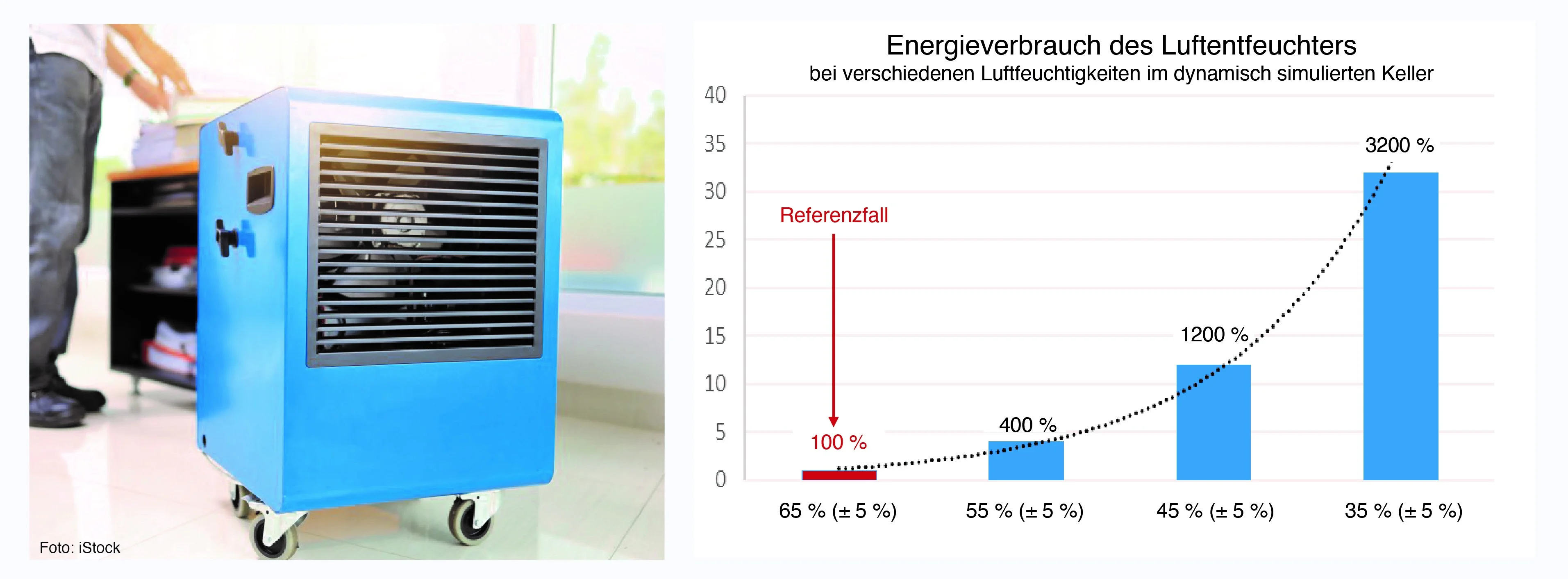
Dehumidifiers ensure dry air in basements, archives and storage rooms, and protect buildings from damp and mould. But to what extent do the choice of appliance and, in particular, the correct settings affect energy consumption? Researchers at the ZHAW School of Engineering investigated this question on behalf of the Swiss Federal Office of Energy, examining the dehumidifiers available in Switzerland.
The study shows that the Swiss market for dehumidifiers is growing rapidly. Whilst around 15 years ago some 8,000 plug-in units were sold each year, the figure is now likely to be well over 60,000. The reasons for this include tighter building envelopes, better-insulated heating systems and consequently cooler basements, more frequent heavy rainfall events, and falling appliance prices. The annual electricity consumption of all dehumidifiers is estimated at around 100,000 MWh. Added to this is around 85,000 MWh for room air tumble dryers.
However, the study also shows that the most effective way to reduce energy consumption often lies not in the technology itself, but in user behaviour. Many people set the humidity level based on how they feel, setting the devices unnecessarily low. It is precisely this that can lead to a massive increase in electricity consumption.
Researchers at the Institute for Energy Systems and Fluid Engineering (IEFE) have demonstrated this using a dynamic simulation of a typical basement room: as soon as the humidity is reduced to below 60% relative humidity, energy consumption rises sharply because the running time of the equipment increases significantly. For example, if the air is dehumidified to 35% relative humidity instead of 65%, annual energy consumption increases thirtyfold. This is because the drier the air is, the more difficult and inefficient it becomes to ‘remove’ further water.
The authors therefore recommend dehumidifying the air only to the extent that is actually necessary. To enable users to set the relative humidity at the level that is optimal in terms of energy efficiency, manufacturers and retailers should not specify the entire permissible humidity range – for example, 40 to 60% relative humidity for a basement – but rather the actual target value for dehumidification. In many cases, a basement does not need to be dehumidified to below 60% relative humidity in order to protect stored items and the building from moisture damage.
The accuracy of the hygrostats also plays an important role. Even small measurement errors can cause a unit to run more frequently and for longer than necessary. Simulations show that, in extreme cases, a deviation of just 2% in the hygrostat can increase energy consumption by up to 40%.
In addition, the study recommends revising the existing test standard EN 810. This is because many appliances are currently tested under laboratory conditions (30 °C, 80% relative humidity), which bear little resemblance to actual operating conditions in Switzerland and Central Europe. The authors therefore propose using more realistic test conditions – for example, 15 °C and 60% relative humidity. To ensure better comparability of energy consumption, all appliances should also be tested under the same conditions.
Finally, the authors suggest that energy-efficient appliances should be labelled more clearly and that eligibility criteria for subsidies should be aligned more closely with actual energy efficiency. This would make it easier for users to identify which appliances are truly energy-efficient in everyday use.
https://pubdb.bfe.admin.ch/de/publication/download/12639
Project name
Studie zur Energieeffizienz von Luftentfeuchtern
Third party funding
Bundesamt für Energie, Eva Geilinger
Participants
Projectleader: Mirco Ganz, ZHAW
Projectteam: Frank Tillenkamp, ZHAW, Niels van Meurs, ZHAW
Projektpartner: Thomas Lang, zweiweg gmbh
Project duration
April 2025 to April 2026