Espaces Croisés: Building Culture Contact Zones along the Swiss Language Border since 1960
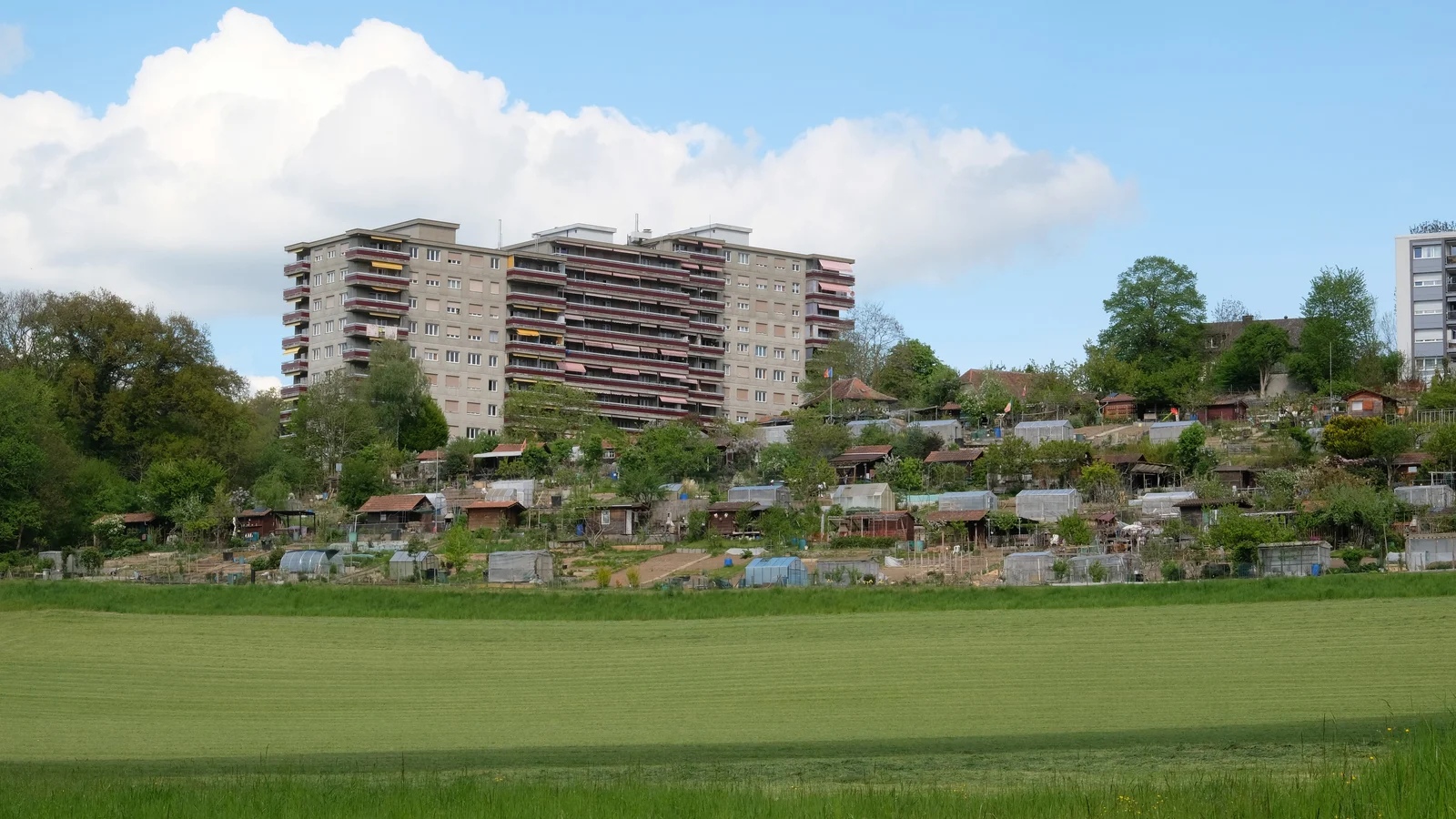
The project investigates how, since the 1960s, a distinct planning culture has emerged along the Swiss German–French language border (Röstigraben), materializing in architecture and urban design, becoming visible and negotiable in social practices, and exhibiting specific characteristics of building culture today.
Description
Switzerland is set to become increasingly urban in the coming decades; in particular, medium-sized cities and well-connected tourist regions are expected to experience significant urbanisation (Federal Statistical Office 2024). These include Delémont, Biel/Bienne, and Fribourg/Freiburg, as well as the Saanenland and Valais. What these places share is that they are located along the German–French language border—one of Switzerland’s central socio-cultural spaces.
The project argues that this language border is not only linguistic but also materially embedded in architecture, urban design, and planning practices, giving rise to a distinct building culture. In light of projected accelerated urbanisation, the project asks how this building culture along the language border has emerged, what characterises it, and how it can be mobilised as a resource for future development. Despite its national significance, there has so far been no systematic architectural, urban, or spatial-historical study of this border.
The project is based on the hypothesis that a distinct planning culture has developed in the urbanised regions of the Jura, Biel/Bienne, Fribourg/Freiburg, the Pays d’Enhaut, and Valais, shaped by the spatial overlap of two language cultures. Against this background, the project investigates for the first time how, along the so-called “Röstigraben” (Büchi 2003), spatial overlaps have materialised in the built environment since the urbanisation of the 1960s, how they have become visible and perceptible in social practices, and what building-cultural value they hold today. The aim is to define the building-cultural identity of these regions in order to provide a robust foundation for future development.
Conceptually, the study draws on Mary Louise Pratt’s notion of the contact zone (1991), which describes spaces where different cultural orders meet and are negotiated. Such contact zones become tangible where spatial overlaps render differences as well as commonalities architecturally manifest (Avermaete/Nuijsink 2021) and socially perceptible: in housing developments and neighborhoods, public buildings, and transport nodes whose formation results from the entanglement of different planning logics. Along the language border, these building-cultural contact zones are examined as observable outcomes of institutional, administrative, and design-based coexistence.
Grounded in a relational understanding of space (Lefebvre 1991; Löw 2001; Schmid 2005; Frehse 2025), which conceives space as the product and configuration of social processes, the project is structured around three key questions: (1) How did architects, planners, and public authorities develop projects along the language border, and which guiding principles, procedures, and conflicts shaped them? (2) Which social routines and everyday practices emerged along the built language border, and how did these practices shape spatial perceptions and memories? (3) How do these contact zones manifest today, and how can they be made visible and communicable through new sources—photographic series, interviews, drawings, and mappings?
Methodologically, the project integrates archival, audiovisual, and oral sources; analysis and dissemination are intertwined from the outset within a process of knowledge production (O’Neill et al. 2016). The results will include a typology of building-cultural contact zones, a methodological framework for integrating heterogeneous sources, and— as a central output—an atlas of building-cultural contact zones along the Swiss language border. This atlas connects historical layers with contemporary spatial practices, situates hybridity, and provides orientation knowledge as both a scholarly and curatorial tool for planning, policy, and society.
Key data
Co-Projectlead
Prof. Dr. Maxime Zaugg, Prof. Dr. Silvia Berger Ziauddin (Universität Bern)
Project team
Prof. Dr. Alexandre Duchêne (Universität Freiburg), Prof. Dr. Janina Gosseye (Delft University of Technology), Charly Jolliet (Charly Jolliet Architecte Sàrl), Prof. Dr. Christian Rohr (Universität Bern), Enrico Slongo (Stiftung Baukultur Schweiz (SBS))
Project partners
Universität Bern / Historisches Institut; Universität Freiburg / Institut für Mehrsprachigkeit; Delft University of Technology / Chair of Building Ideologies; Charly Jolliet Architecte Sàrl; Stiftung Baukultur Schweiz (SBS)
Project status
Start imminent, 02/2027
Institute/Centre
Institut Urban Landscape (IUL)
Funding partner
SNF Projektförderung
Project budget
1'002'720 CHF
Partner

Further documents and links
School of Architecture, Design and Civil Engineering
Tössfeldstrasse 11
8400 Winterthur