Swiss rooftops are producing more and more solar power
New photovoltaic systems on rooftops across Switzerland are now significantly larger than they were just a few years ago. A recent study undertaken by the ZHAW reveals that newer systems utilise, on average, almost 80 percent of rooftop potential that is technically and economically usable.

In Switzerland, the expansion of photovoltaics has accelerated greatly in recent years – especially on the country’s rooftops. This development is a necessary step as Switzerland strives to significantly increase energy production from new renewable sources in line with Swiss expansion objectives for 2030 and 2035. A ZHAW study has now investigated how effectively the potential offered by newer systems is being utilised.
To this end, researchers examined 150 buildings across Switzerland on which a PV system had been commissioned since 1 January 2023. They compared the size of the system actually installed with the size that would be possible under near-maximum utilisation of the available roof area. On average, the study found that 79 percent of the existing potential has been utilised.
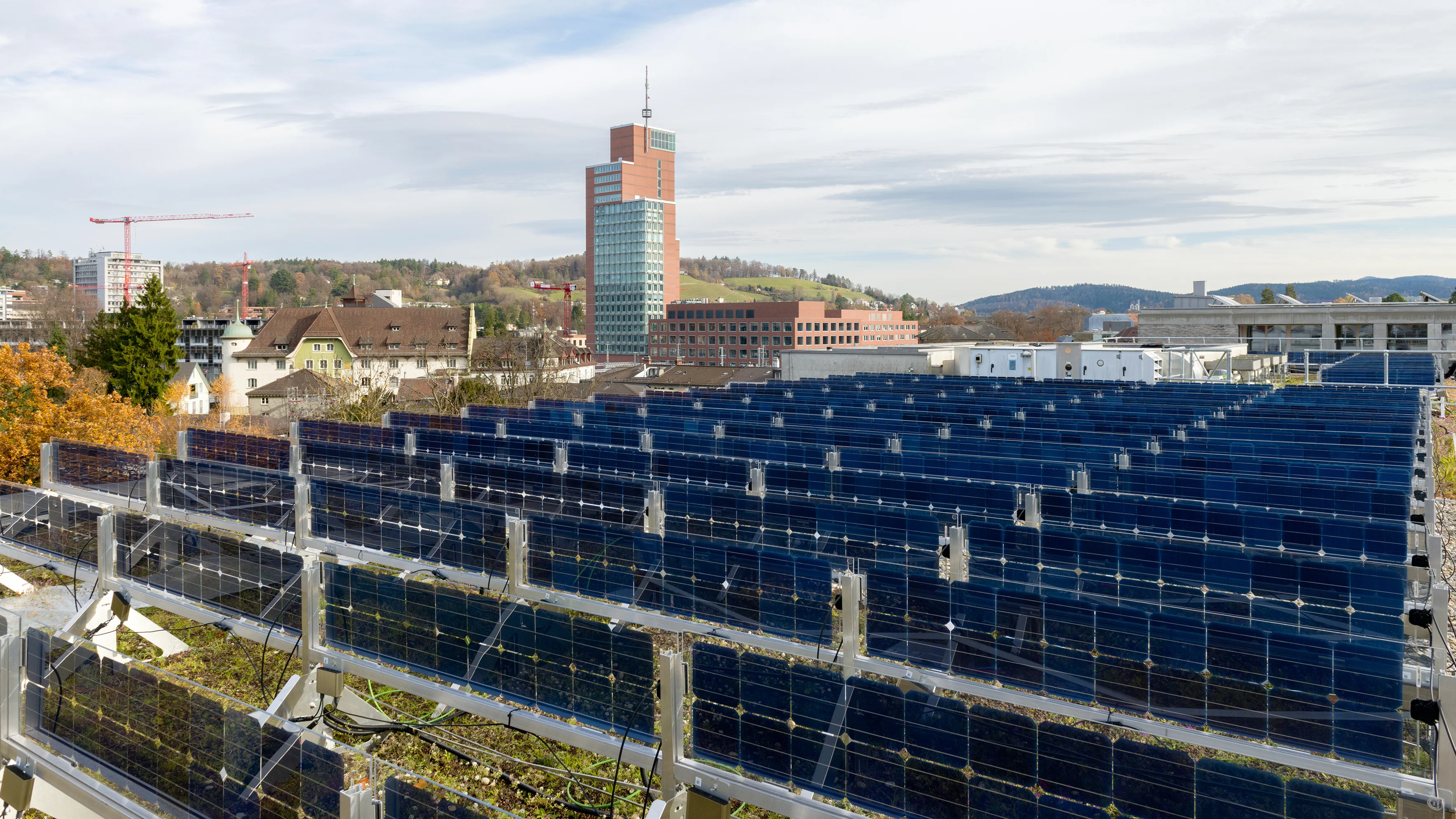
This figure is considerably higher than that suggested by a comparable study covering the period between 2017 and 2021, which indicated a utilisation rate of just 50 percent. “Our investigation reveals a clear trend reversal: those incorporating solar installations on their rooftops are now utilising the available space much more consistently than was the case just a few years ago,” says Professor Jürg Rohrer, Head of the Renewable Energies Research Group at the ZHAW. “This is good news – we could, in purely theoretical terms, already almost achieve the national expansion targets for renewable energies using existing rooftops.”
The research work presented in this publication was conducted with the support of the Swiss Federal Office of Energy as part of the SWEET EDGE consortium. The authors bear sole responsibility for the results and conclusions set out in this publication.
The potential offered by small buildings is almost fully utilised
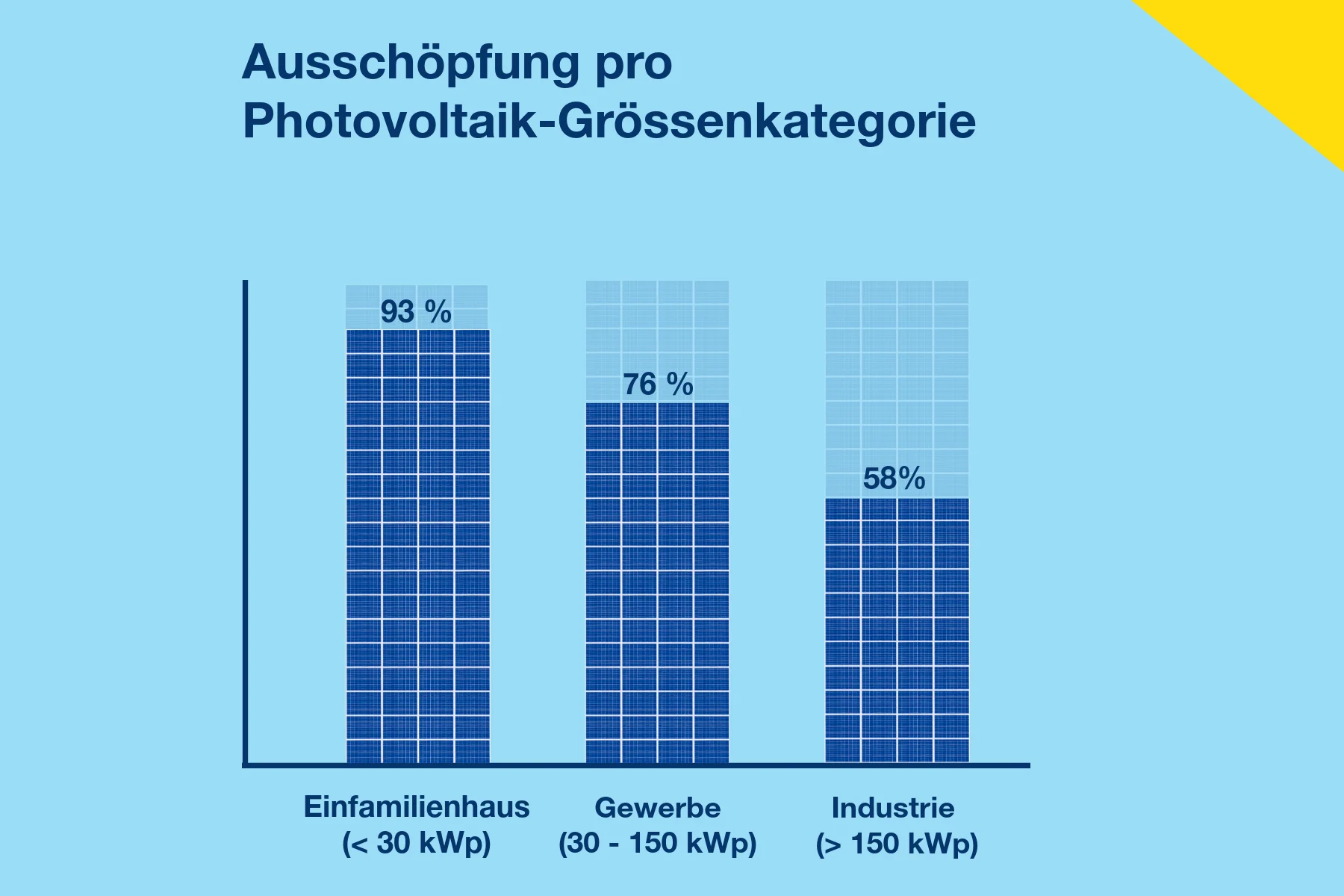
However, the degree to which this potential is realised varies greatly between the different building size categories: in small buildings (typically single-family homes with potential rated output of less than 30 kWp), it was found that 93 percent of the available potential was utilised on average. For medium-sized buildings (e.g. larger residential buildings and commercial properties, 30 to 150 kWp), this figure stood at 76 percent. Due to complex ownership structures, such as condominium ownership arrangements, the utilisation and billing of collectively generated solar power in these buildings is significantly more challenging, which is slowing down expansion. On large rooftops (industrial, logistics and large public buildings with a potential rated output of in excess of 150 kWp), a utilisation rate of 58 percent means significant reserves remain untapped.
Uncertainty with respect to future framework conditions
If new PV systems continue to make similarly consistent use of rooftops as they did in 2023 and 2024, the expansion targets for renewable energy anchored in the Federal Electricity Supply Act could, in purely theoretical terms, be achieved using rooftop photovoltaics alone. However, for this to become a reality, the rate of expansion would have to increase considerably.

“At present, it is not a lack of rooftops that is slowing utilisation, but rather the general conditions in place. Feed-in tariffs and subsidy conditions are subject to continuous change, resulting in a lack of investment security. To keep the rate of expansion high or drive it even further, we need stable and reliable rules for investments in new photovoltaic systems.”
Prof. Jürg Rohrer
Contact
- Prof. Jürg Rohrer, Renewable Energies Research Group, Institute of Natural Resource Sciences, School of Life Sciences and Facility Management, juerg.rohrer@zhaw.ch
- Beatrice Huber, Media Relations, ZHAW School of Life Sciences and Facility Management, +41 58 934 53 66, beatrice.huber@zhaw.ch