Galactic Alchemy: Deep Learning Map-to-Map Translation in Hydrodynamical Simulations
A new research publication pioneers the use of generative AI to bridge HPC simulations of the early universe with observational data obtained by radio telescopes.
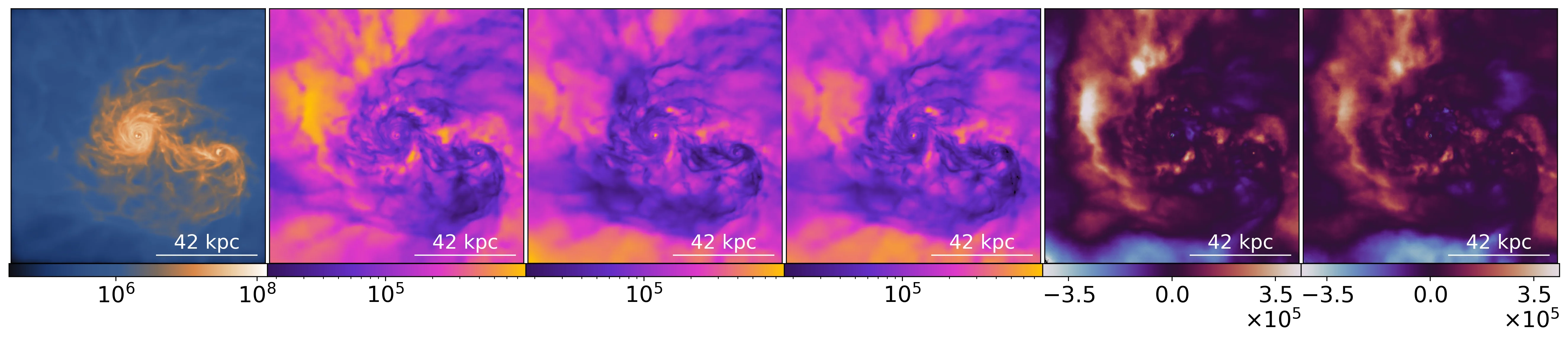
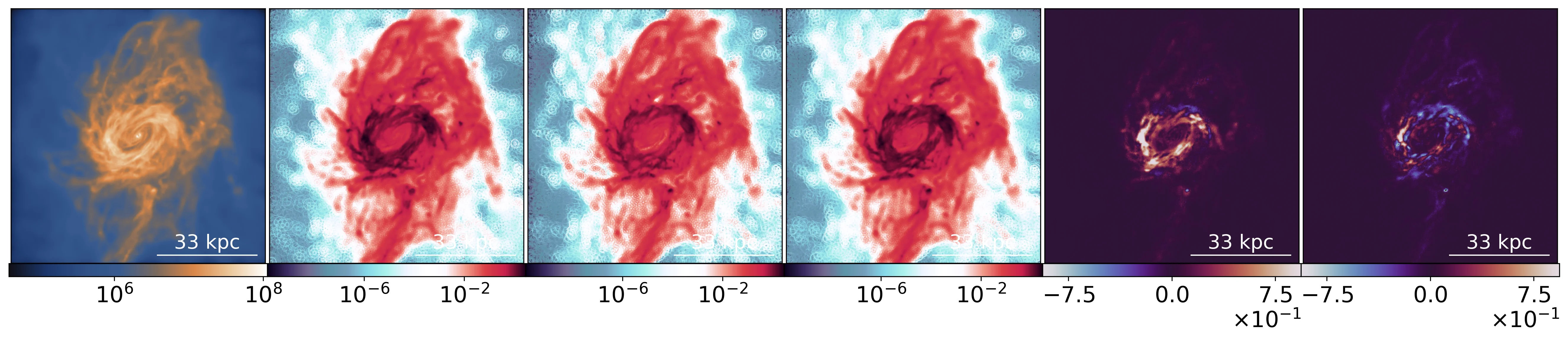
A new paper, “Galactic Alchemy: Deep Learning Map-to-Map Translation in Hydrodynamical Simulations” by CAI’s Intelligent Vision Systems (IVS) group has recently been published in the Monthly Notices of the Royal Astronomical Society (MNRAS), one of the most prestigious journals in Astronomy/Astrophysics.
Since 2022, ZHAW researchers from CAI (Dr. Philipp Denzel, Dr. Frank-Peter Schilling) and SML’s IWI (Dr. Elena Gavagnin) participate, jointly with other Swiss universities including ETHZ, UZH and EPFL, in the SKACH consortium, Switzerland’s contribution to the global SKAO (Square Kilometre Array Observatory) organization, building the biggest radio-telescope in the world, currently under construction at two sites in South Africa and Australia.
The SKA has not only the potential to significantly advance our understanding of the Universe, it is also a tremendous data science project. During its operation, the SKA will collect unprecedented amounts of data, in the order of 700 Petabytes per year, requiring the world’s fastest supercomputers to process this data in near real time, before turning these into science products.
The SKA research at ZHAW focuses on applying AI and deep learning methods to various tasks related to the interpretation of observational data to unveil the underlying physics, as well as to bridge HPC simulations of the early universe and observations made by the SKA.
The new publication falls in the second category. It demonstrates that generative deep learning models (diffusion models or generative adversarial networks) can transform galaxy formation research by bridging simulations and observations (e.g. by the SKA telescope), reducing reliance on costly, repeated HPC simulation runs. It marks a significant step towards efficient, next generation modelling pipelines, automated survey interpretation, and managing the ensuing data deluge in the SKA era.
The paper presents the first systematic study of multi-domain map-to-map translation in galaxy formation simulations, leveraging deep generative models to predict diverse galactic properties. Using high-resolution magneto-hydrodynamical simulation data (from the IllustrisTNG suite), we compare conditional generative adversarial networks (GANs) and diffusion models under unified preprocessing and evaluation, optimizing their U-Net architectures and attention mechanisms for physical fidelity on galactic scales.
Our approach jointly addresses seven astrophysical domains - including dark matter, gas, neutral hydrogen, stellar mass, temperature, and magnetic field strength - while introducing physics-aware evaluation metrics that quantify structural realism beyond standard computer vision measures.
We demonstrate that translation difficulty correlates with physical coupling, achieving near-perfect fidelity for mappings from gas to dark matter and mappings involving astro-chemical components such as total gas to HI content, while identifying fundamental challenges in weakly constrained tasks such as gas to stellar mass mappings.
Our results establish GAN-based models as competitive counterparts to state-of-the-art diffusion approaches at a fraction of the computational cost (in training and inference), paving the way for scalable, physics-aware generative frameworks for forward modelling and observational reconstruction in the Square Kilometre Array (SKA) era.
Link to the paper: https://doi.org/10.1093/mnras/stag155