Master’s profile in Conference Interpreting
Interpreting live at the EU, the UN or specialist conferences – enabling effective national and international communication at the highest level.
In the profile in Conference Interpreting of the MA in Language and Communication, you are in the interpreting booth from day one. You learn the techniques and strategies of simultaneous and consecutive interpreting under close supervision from experienced lecturers who themselves are professional interpreters and prepare for professional, service-oriented practice and entry into the profession of a conference interpreter.
Programme
In the core models, you acquire the academic and methodological foundations. In your profile, you gain practical professional expertise.
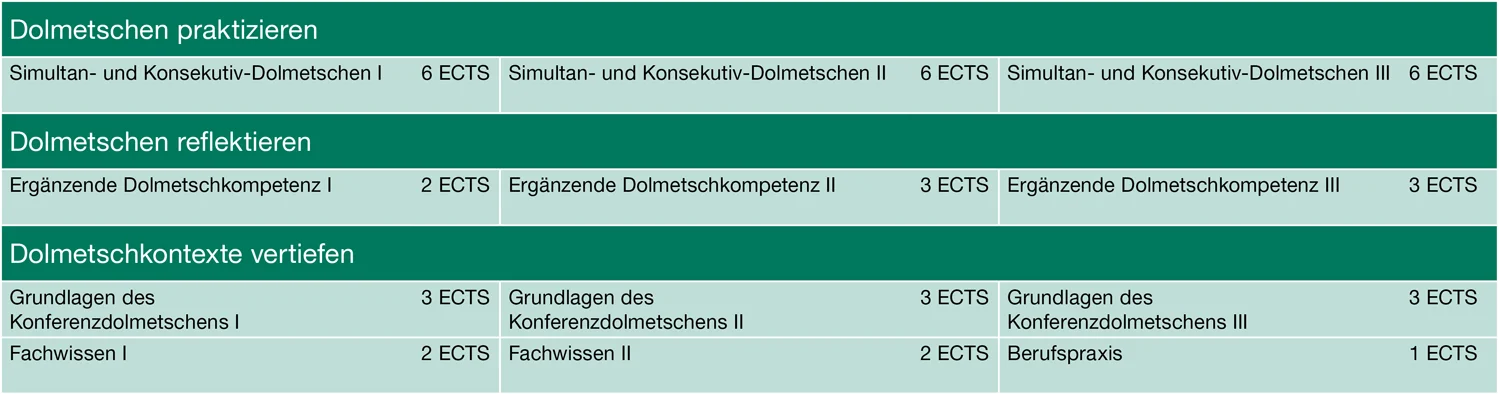
In the profile in Conference Interpreting, you acquire outstanding interpreting competencies and learn everything you need for daily professional practice as a conference interpreter.
Focus areas:
- Simultaneous and consecutive interpreting
- Speech training (voice production, rhetoric and speaking technique)
- Memory training
- Note-taking
- Terminology work
- Interpreting studies
- Professional skills
You gain practical confidence through:
- conference simulations in which you practice your interpreting skills under real working conditions,
- practice assignments in the “silent booth,” and
- voluntary interpreting assignments with charitable organisations.
You study with experienced conference interpreters who prepare you in the best possible manner for self-employment and professional entry with practical tips and tricks from professional practice.
Information on full-time/part-time study: information sheet on Conference Interpreting study models
Languages of study
You take at least two and a maximum of four languages of study.
The following language combinations are possible:
- AB
- ACC
- ABC
- ACCC
One of the languages you pursue must be German.
The results you achieve in the professional aptitude test will determine which of your languages are classified as A, B and/or C.
A, B and C languages
- Your A language is your native or primary language.
- Your B language refers to an active foreign language into and out of which you translate and work.
- C languages are passive second languages out of which you translate and work.
Available languages of study (subject to change)
| A language | B or C languages |
|---|---|
| German | French, Italian, English, Spanish |
| French | German, Italian, English, Spanish |
| Italian | German, French, English, Spanish |
| English | German, French, Italian, Spanish |
| Spanish | German, French, Italian, English |
Insights into the programme and profession
-

Nicht auf den Mund gefallen – Ein Alumniporträt
Ob Kamala Harris, Pia Sundhage oder Evo Morales: Dana Widmer ist Konferenzdolmetscherin und hat schon vielen interessanten Menschen ihre Stimme geliehen. Ist das Dolmetsch-Mikro an, läuft die ...
-

Konferenzdolmetscher:innen tauchen ständig in neue Welten ein. Madlaina über Beruf, Masterstudium und Zukunft
Vor fünf Jahren schloss Madlaina den Master Language and Communication mit Vertiefung Konferenzdolmetschen an der ZHAW ab. Heute ist they als selbstständige:r Konferenzdolmetscher:in für Deutsch, ...
-

Raus aus der Übungskabine, rein in die Internationalen Kurzfilmtage – Dolmetscherinnen im Einsatz
Studentinnen der Mastervertiefung Konferenzdolmetschen durften an den Internationalen Kurzfilmtagen Winterthur die Preisverleihung verdolmetschen. Sokhawy Lo hat ihre Studienkolleginnen bei ihrem ...
Career opportunities
With this profile, you are fully qualified to work as a conference interpreter.
- In Switzerland, conference interpreters generally work on a freelance basis.
- International organisations or parliamentary services also employ conference interpreters in salaried positions.
Working on an assignment basis exposes you to a very wide variety of subject areas and allows you to gain insights behind the scenes of many different sectors.
Typical clients:
- Government bodies
- International companies and organisations such as the EU and UN
- Television broadcasters
- Specialist conferences and congresses
- Foundations, associations, political parties, NGOs, etc.
Entry requirements
The profile in Conference Interpreting is suitable for graduates from all Bachelor's disciplines who have excellent language skills in at least two languages.
What we expect from you
A Bachelor’s degree and excellent language skills in the selected two to four languages of study are required for admission to the programme. You must also pass a professional aptitude test.
In addition, you will need to possess the following attributes if you are to successfully manage your everyday study and professional life:
- Strong written and oral communication skills in various contexts
- The ability to grasp new concepts quickly
- Creativity in problem-solving
- Intellectual curiosity
- Resilience
- The ability to handle criticism and maintain focus
- Thorough knowledge of the economic, social, political and cultural conditions in the cultural areas of your languages of study
Preparation
- Stays abroad
- Highly recommended: attendance of the one-semester conference interpreting bridging course
Conference interpreting bridging course
The conference interpreting bridging course systematically prepares you for the professional aptitude test and the subsequent MA programme. In the course, you acquire the fundamentals of interpreting, close any gaps in your knowledge and receive individual support from our lecturers.
- Duration: September to December
- Application deadline: 15 May
- Admission test: July