Master’s profile in Multilingual Communication Management
Master multiple languages and language technologies with confidence and apply them strategically – for multilingual communication management, culturally appropriate professional translations and accessible communication.
In the profile in Multilingual Communication Management of the MA in Language and Communication, you further develop your affinity for languages, harness your creativity and build expertise in the areas of language technologies, language consulting and language management.
This enables you to:
- translate complex texts as well as plan and coordinate demanding translation projects,
- facilitate accessible communication across languages and cultures,
- drive innovation in language technologies, and
- strategically shape multilingual communication in advisory or specialist leadership roles.
Programme
In the core models, you acquire the academic and methodological foundations. In your profile, you gain practical professional expertise.
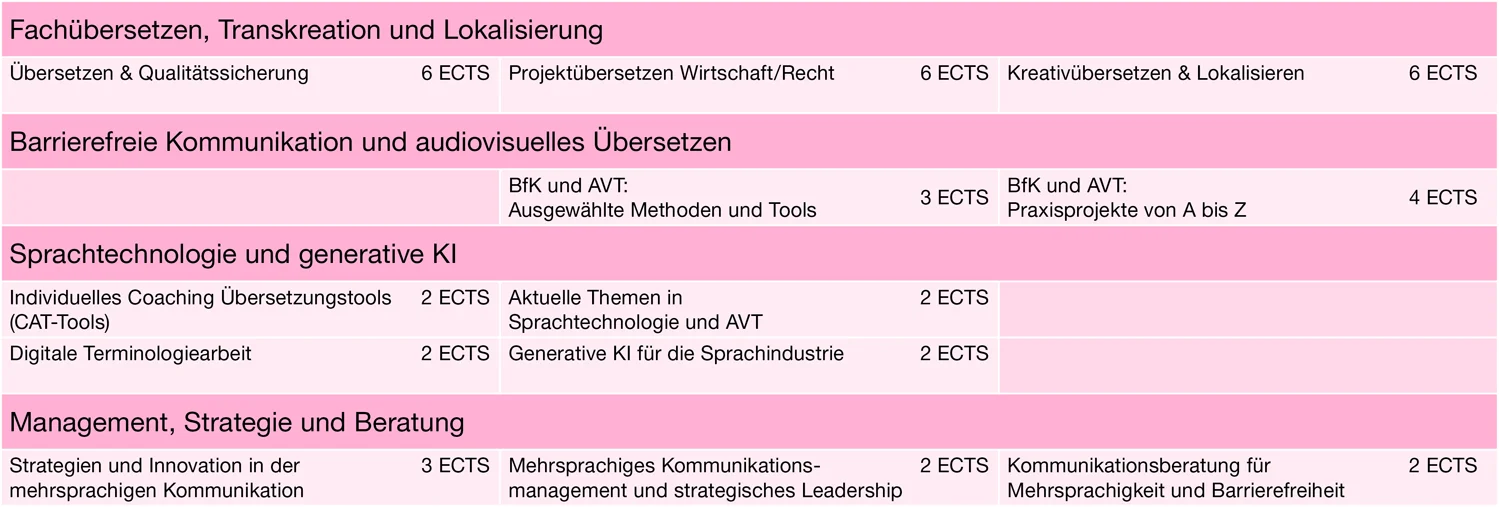
In the profile in Multilingual Communication Management, you learn everything needed to work as an expert or consultant for multilingual and accessible communication, including how to translate and convey complex content for different target groups and cultural contexts.
Focus areas:
- Professional translation (including quality assurance), transcreation and localisation
- Accessible communication (audio description, respeaking and easy language)
- Audiovisual translation (subtitling)
- Language technologies, terminology work and generative AI
- Management, strategy and consulting
You acquire a broad set of skills and expertise for working in the language industry, including:
- profound linguistic, cultural and translation competencies,
- confident use of language technologies and AI,
- innovation skills,
- creativity, precision and intercultural sensitivity, and
- management and consulting skills.
You round off your personal competence profile with your Master’s thesis, in which you develop research-based solutions for a current topic from the language industry or the fields of language technology, multilingual communication or accessible communication.
Information on full-time/part-time study: information sheet on Multilingual Communication Management study models (in German)
Insights into the degree programme
-

Augmented Translation bringt neue Möglichkeiten. Ein Alumniportrait
Jessica Selinger ist Übersetzerin beim Bund und Expertin für KI beim Übersetzen. Die Absolventin des Masters Language and Communication hat schon im Studium angefangen, mit Maschineller Übersetzung zu ...
-

Game-Lokalisierung ist kein Kinderspiel
Wie beeinflusst Game-Lokalisierung das Spielerlebnis und warum ist sie entscheidend für den Erfolg von Videospielen? In ihrer Masterarbeit hat sich die passionierte Gamerin Christina Capizzi mit der ...
-

«Übersetzen in Leichte Sprache ist gar nicht so leicht»
Studierende der Mastervertiefung Multilingual Communication Management (bisher: Fachübersetzen) haben für eine Kunstausstellung im Gewerbemuseum Winterthur Texte in Leichte Sprache übersetzt. Was die ...
Languages of study
You take two or three languages of study:
- Your native or primary language (A language)
- An active foreign language (B language) or two passive second languages (C languages)
One of the languages you pursue must be German.
The results you achieve in the professional aptitude test will determine which of your languages are classified as A, B and/or C.
A, B and C languages
- Your A language is your native or primary language.
- Your B language refers to an active foreign language into and out of which you translate and work.
- C languages are passive second languages out of which you translate and work.
Available languages of study (subject to change)
| A language | B or C languages | C language only |
|---|---|---|
| German | French, English, Italian, Spanish | Chinese |
| French | German, English, Italian | |
| Italian | German, English, French | |
| English | German, French, Italian, Spanish | |
| Spanish | German, English |
Career opportunities
With the profile in Multilingual Communication Management, you qualify for a specialist or leadership role in the language industry – working on either a self-employed or employed basis.
Your tasks may include:
- intensive and creative work with texts, languages and language technologies: professional translation, audiovisual translation and accessible communication,
- strategic design of multilingual communication across all industries,
- adaptation of communication to various target groups and cultural contexts – responsibly, sustainably and with an individual touch,
- the informed use of language technologies and AI in multilingual communication,
- strategic multilingual communication management,
- close collaboration with experts from other industries, or
- consulting on multilingual communication.
Possible roles:
- Language expert
- Expert in multilingual communication management
- Translator
- Expert in accessible communication
- Expert in multilingual information management and translation consulting
- Expert in language technologies
- Terminologist
- Respeaker
- Subtitler
Typical employers:
- Language service providers and language solution integrators
- Companies in the private sector and industry
- National and international organisations and authorities
- Trade unions and associations
- Film and television
- Self-employment in your own business
Entry requirements
The profile in Multilingual Communication Management is suitable for graduates from all Bachelor's disciplines who have excellent language skills in at least two languages.
The profile is therefore suitable for graduates from the following disciplines:
- Linguistics and literary studies
- Humanities and social sciences
- Health sciences
- Business and law
- Engineering
- Natural sciences
- and more
The MA in Language and Communication offers you an ideal qualification for entering the language industry.
What we expect from you
A Bachelor’s degree and excellent language skills in the selected two or three languages of study are required for admission to the programme. You must also pass a professional aptitude test.
Furthermore, you will need to possess the following additional qualities if you are to successfully manage your everyday study and professional life:
- Strong written and communication skills in various contexts
- The ability to grasp new concepts quickly
- Creativity in problem-solving
- Intellectual curiosity
- Resilience
- The ability to handle criticism and maintain focus
- Presentation skills
- Thorough knowledge of the economic, social, political and cultural conditions in the cultural areas of your languages of study