Silicone muscle for more accurate load testing of the shoulder
With the shoulder simulator developed by the Institute of Mechanical Systems, the MyoPlus project-team simulates and measures the loads acting on individual muscle portions of the Deltoid. This helps to understand how the shoulder joint behaves in different situations, such as after injuries to plan a corrective surgery or verify an implant.
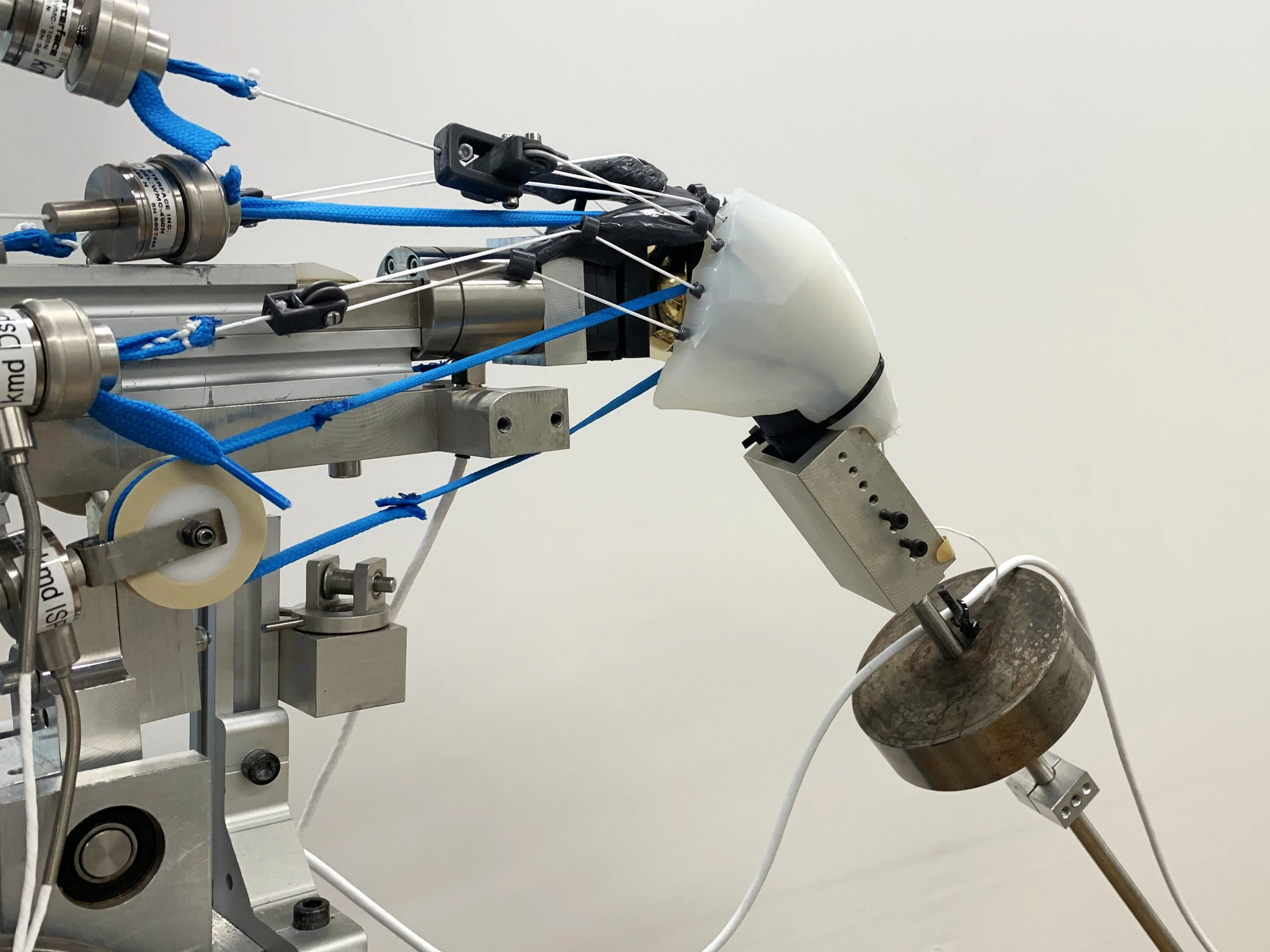
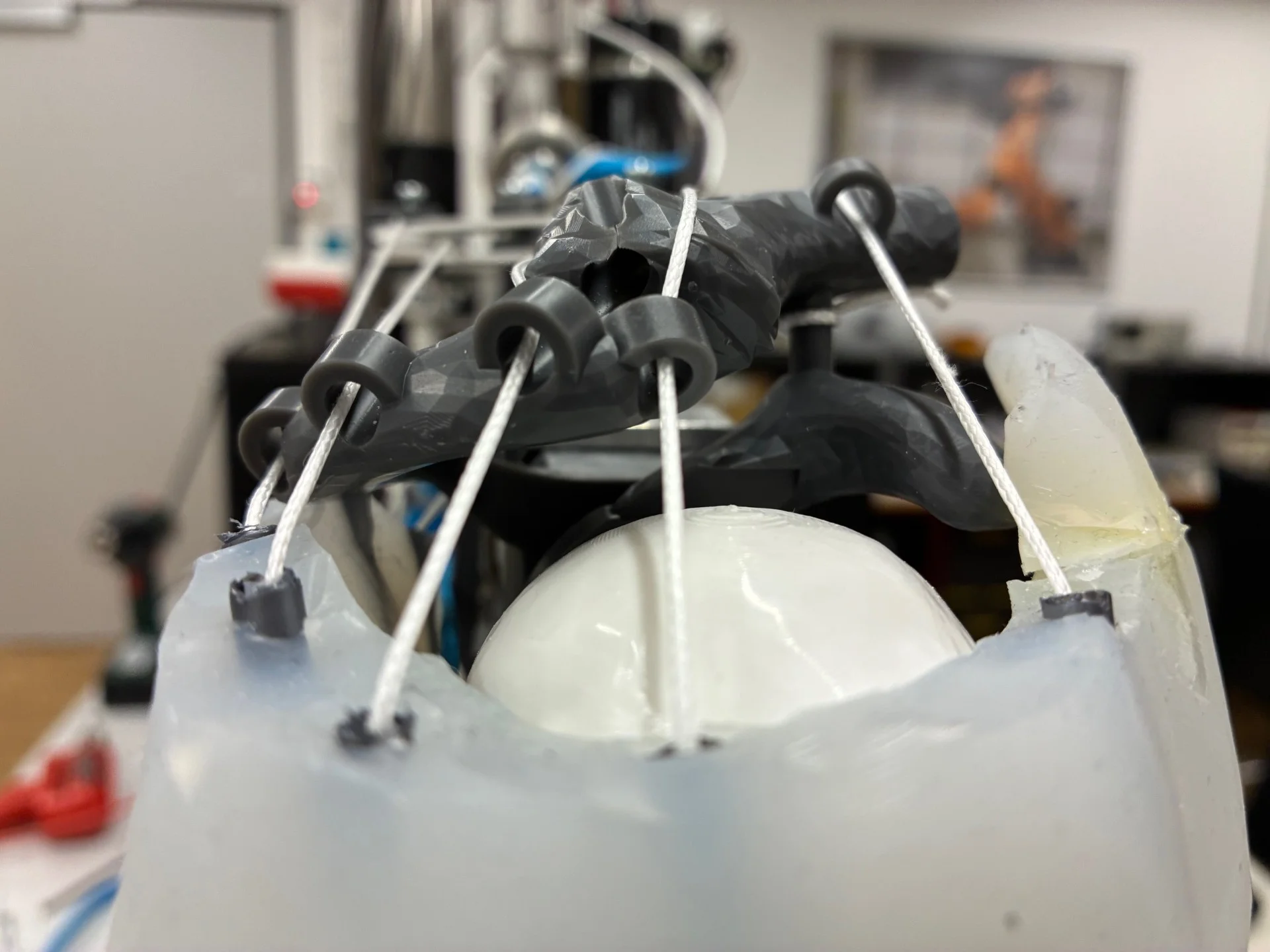
In the EELISA project MyoPlus, conducted by the Institute of Mechanical Systems (IMES) together with Sant’Anna University in Pisa, innovative muscle models are being developed and validated for experimental testing of natural joints and implants. Specifically, the EELISA project focuses on creating a voluminous model of the Deltoid. This replicates the moment arms, the distances between the joint and the muscle attachment points, of a physiological shoulder better than the previous model, which ran the model muscle portions directly over the bone. Realistically simulating human muscles is highly challenging due to their complex biomechanical behaviour, as they always work in interaction with joints, tendons, and ligaments. Yet, such simulations are essential for understanding how a body part behaves, especially after medical procedures or injuries.
“Muscles are particularly important in the shoulder”
The work at IMES within the MyoPlus project focuses on the shoulder – partly because shoulder prostheses deliver less predictable long-term results than those of other body parts. “From a biomechanical perspective, the shoulder joint is far more complex than the hip or knee. Muscles are crucial to joint function in the shoulder. The deltoid muscle, being the strongest muscle in the shoulder area, plays a decisive role in movement control,” says Molly Abraham, research assistant at IMES specializing in biomechanical engineering. “After surgery, muscle performance decreases, which has a particularly strong impact on the shoulder.” For this research, the institute uses a mechanical shoulder simulator that allows the team around projectlead Daniel Baumgartner, Jeremy Genter, and Molly Abraham to carry out a wide range of tests.
Investigating Muscle Loads
The shoulder simulator replicates a shoulder blade (scapula), the joint (gleno-humeral joint), and an upper arm (humerus) by custom 3D prints. The weight of the entire arm is modelled by attaching weights to the 3D printed humerus. To create an even more realistic model, it is complemented by a silicone reproduction of the deltoid muscle connected via cables to motors which articulate the joint. Other muscles in the shoulder area are modelled by shoelaces also driven by motors. The combination makes it possible to lift and rotate the mechanism, enabling a natural imitation of human shoulder movements. Various measuring devices, including load cells and gyroscopes, are attached throughout the simulator to determine where and how forces act. By omitting individual connections, injuries and muscle failures are simulated. This makes it possible to analyse the loads on individual muscle portions.
“Since the start of the project, we have continued to develop the muscle model, bringing it closer to physiological conditions.”
— Molly Abraham, Research Assistant at IMES
The measurement results show how closely muscle strength, joint centring, and biomechanical load distribution are interconnected. Even small changes significantly influence the force relationships within the shoulder joint. “What is particularly interesting is that intact muscles try to compensate for deficits caused by injuries to other muscles,” says Molly Abraham. “However, the muscles cannot take over the full load, which can lead to further medical issues.” The simulations at IMES help researchers understand such problems so they can be avoided in real patients.
“A perfect project partner”
The EELISA project partner Sant’Anna in Pisa developed a similar silicone model of the deltoid muscle used at IMES. In the project, the Italian team works with McKibben actuators, pneumatic artificial muscles, to articulate the joint using air pressure rather than cables. “Sant’Anna is the perfect project partner for our shoulder simulations,” says Molly Abraham. “We also had the opportunity to visit the university, which was extremely impressive. Around 200 people work at just one institute dedicated to medical technology.”
Optimising Medical Care
The results of the MyoPlus project showed that by modelling the volume of the Deltoid, the forces to actuate motion were reduced. Therefore, testing without such a model may lead to increased forces as the physiological moment arms are not considered. The use of a volumetric model enables more accurate evaluation of surgeries, implants, and rehabilitation strategies for the shoulder. The project also highlights the continued potential of mechanical simulation of body parts. Each component can be further improved to enable even more realistic modelling. In the long term, the combination of realistic muscle models and simulators may significantly enhance care for patients with shoulder diseases or injuries.