Matura Project in the ZHAW Wind Tunnel
In the ZHAW wind tunnel, Oskar Vestreli investigated how much the shape of a sail influences propulsive force as part of his high school thesis—and impressively demonstrated that geometry counts for more than surface area.
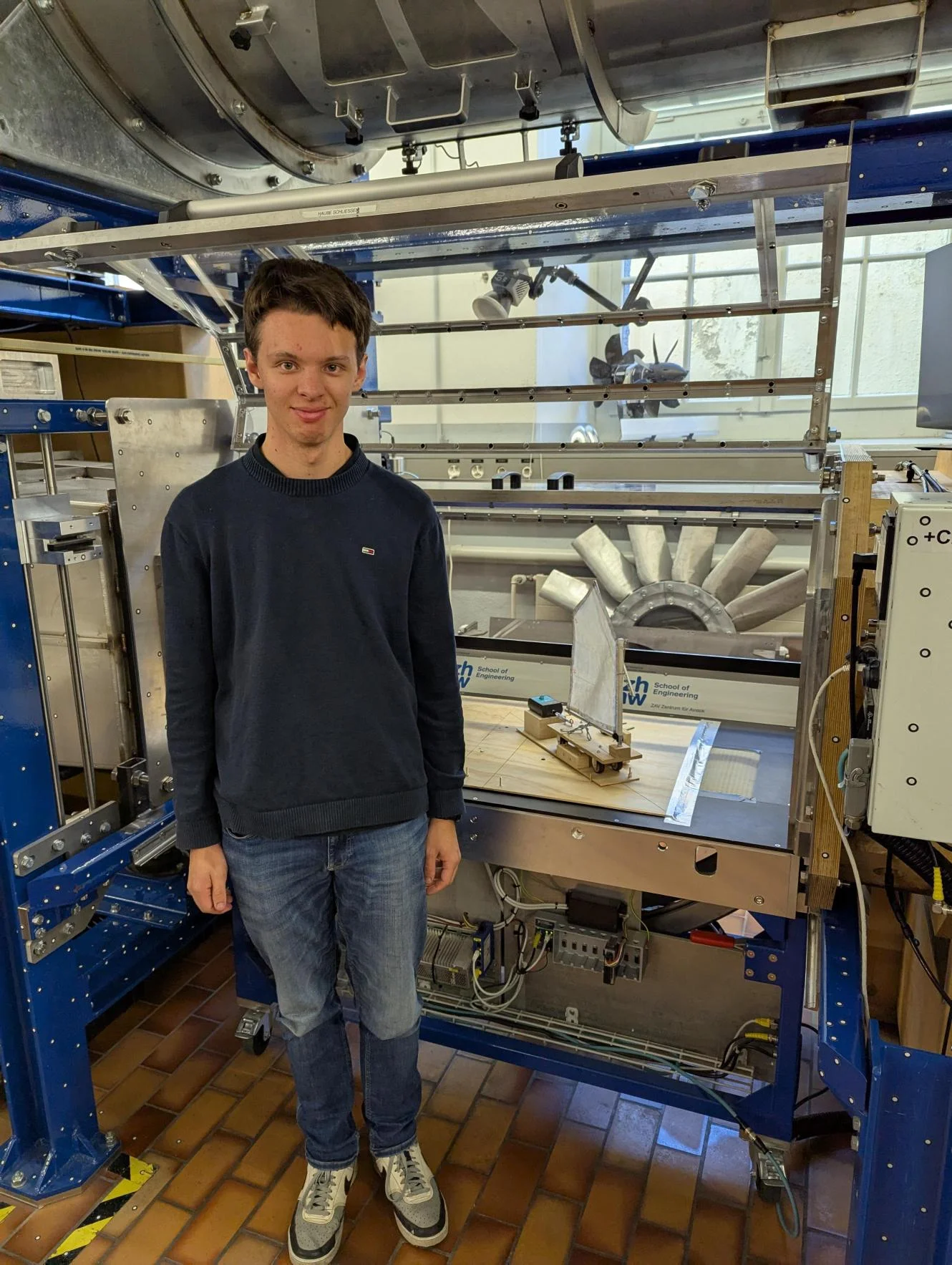

As part of his Matura project at Uster Gymnasium, Oskar investigated the extent to which the geometric shape of a sail affects the propulsive force it generates. In many simplified formulas, the area of the sail is the only factor considered, while the shape is barely mentioned. However, the lift theory shows that the geometry plays a crucial role in the generation of force. So he wondered why this should not be the case for sailboats.
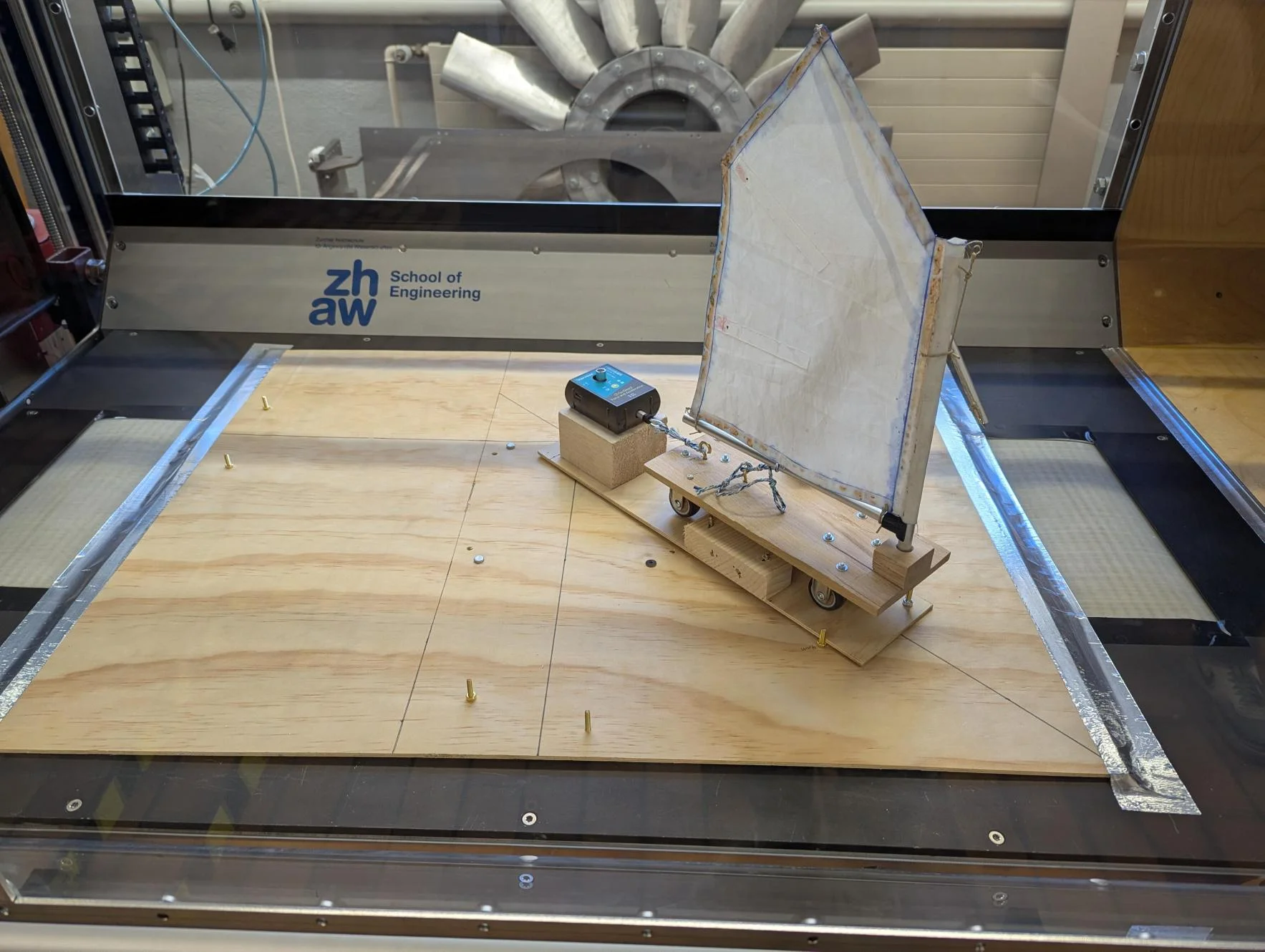
To test this discrepancy, Oskar was allowed to conduct experiments in the ZHAW wind tunnel. He built three model sailboats with sails that differed only in shape – triangle, rectangle and pentagon – but all had the same area. The models were mounted on a carriage that was guided on a rail system and connected to the measuring apparatus via a force gauge. This allowed identical angles to the wind to be set and the propulsive force to be measured with precision. The ZHAW wind tunnel, a closed channel with a turbine, turbulence filter and test area, enabled wind speeds to be reproduced exactly.
Oskar carried out measurements at 10 m/s, 12.5 m/s and 15 m/s, as well as at wind angles of 45°, 90° and 180°. Each combination was repeated several times, with a total of around 68 measurements being taken over a period of three hours. This was made possible by good preparation and the input of the research assistant, who helped him with the set-up.
The results clearly showed that the shape of the sail affects the generated propulsive force. The rectangular sail proved to be the least suitable, as its upper half flapped unstably and contributed little to propulsion. The triangular and pentagonal sails produced similar forces, but it was found that a certain degree of camber is necessary for the airflow to follow optimally. However, turbulence is created around the mast in the upper area of the triangle, which means that the airflow is no longer laminar in some areas. The pentagonal sail proved to be particularly efficient at low wind speeds, as it is stable enough and its length allows the airflow to follow it well. However, it lost stability at higher wind speeds; the upper corner bent backwards and created unfavourable angles of attack, which reduced the force. Under such conditions, the triangular sail produced the best results.
Since wind speeds of over 10 m/s are rare in real sailing, the forces are usually closer together in practice. The chosen course in relation to the wind is then the decisive factor.
The professional infrastructure was available to him free of charge, and he was provided with technical and organisational support by the research assistant. The collaboration enabled him to implement his experimental idea precisely and to gain valuable insights into research and study.