How Co-Creation in PEATLESS Pointed Us Toward Sunflower Straw as a Promising Peat Substitute
With the completion of the first project phase of the EU research project PEATLESS, important insights from the co creation workshops with practitioners are now available. A wide range of organic by-products were discussed as potential peat alternatives, including sunflower straw, which was subsequently examined in greater depth at ZHAW together with other materials.
The first phase of the PEATLESS project focused strongly on exchange with practitioners. Under the coordination of our Geography of Food research group, co‑creation workshops were held across the four project countries: Belgium, Italy, Spain, and Switzerland. The goal was to discuss with producers, advisors, and specialists what requirements reduced‑peat substrates need to meet. During the Swiss workshop, held in September, it became particularly clear how crucial consistent substrate quality is. For young plant production, stable structure, reliable water retention, and homogeneity are essential.
At the same time, the workshop revealed a strong openness toward regionally available organic by‑products that have so far seen little use. Among these, sunflower straw emerged as a promising candidate. In Switzerland, sunflowers are cultivated on more than 7,000 hectares, leaving substantial amounts of plant material after grain harvest, material that could potentially serve as a substrate component.
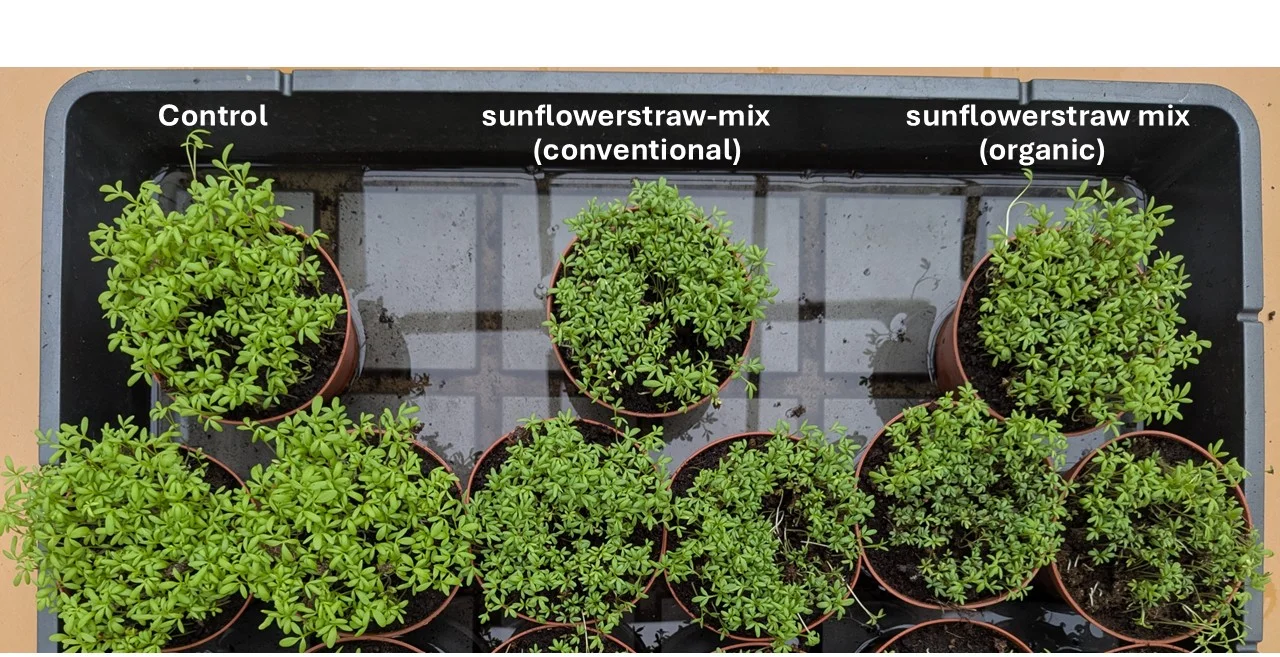
Building on these insights from practice, the ZHAW Horticulture Research Group carried out a series of trials to assess the potential of sunflower straw. In autumn 2026, straw from several farms was collected, chopped, and dry‑defibrated to achieve a more uniform fibre structure, a need frequently raised during the workshops. The processed straw was then incorporated into substrate mixtures in different proportions. Alongside chemical and physical analyses, cultivation trials with garden cress and Chinese cabbage were also conducted.
The results present a nuanced picture: while raw sunflower straw shows comparatively high pH and salt levels, it also provides an attractive combination of structural stability and water‑holding capacity. Particularly when used in moderate proportions, the material performed well.
Overall, sunflower straw shows realistic potential as a component of reduced‑peat substrates—provided it is properly processed and used in carefully adjusted amounts. The insights gained from both practice and research will now feed into the development and testing of new substrate mixtures in the upcoming phases of the PEATLESS project.
Further background the sunflower straw trials can be found in the blog post on the PEATLESS project website: https://peatless.eu/sunflower-straw-peat-substitute/