Clever use of smart meter data
Using an AI-powered data reader that analyses electricity data from smart meters down to the second, thereby identifying PV generators and large consumers, researchers at ZHAW aim to create a tool for predictive energy management. This will enable end customers to analyse their smart meter data – which will be mandatory in 80% of Swiss households by the end of 2027 – and thereby optimally manage their electricity consumption, self-consumption of PV power and battery storage.
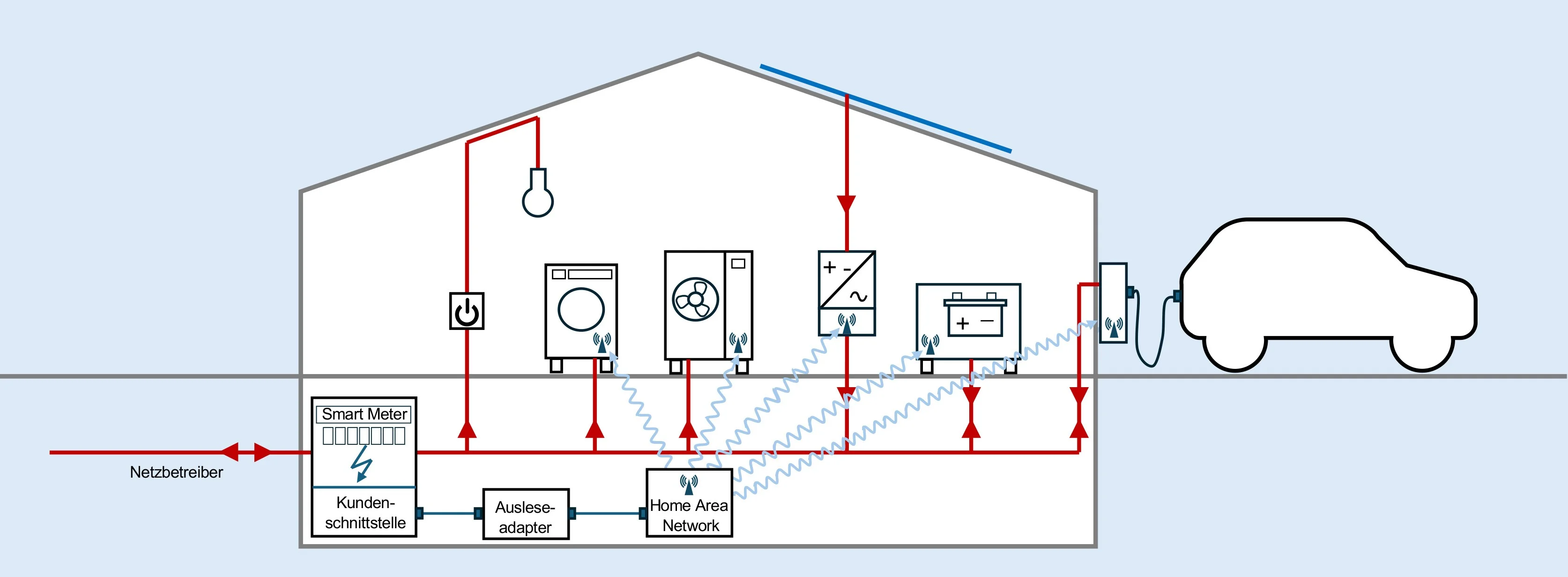
In Switzerland, at least 80% of electricity meters must be replaced with smart meters by the end of 2027. These new meters provide transparency regarding energy consumption, enable flexible tariffs and support the optimisation of self-consumption. At the same time, they are an important tool for stabilising the electricity grid.
Smart meters continuously monitor electricity consumption. Consumption data is averaged every 15 minutes and transmitted to the network operator. This enables the operator to create load profiles, identify peak loads, and manage and dimension the network more efficiently. Technically, it would be possible to transmit consumption data at shorter intervals. However, as such high-resolution data allows the network operator to draw very precise conclusions about household behaviour – such as when someone comes home, cooks, watches television or sleeps – the transmission interval is set at 15 minutes for data protection reasons.
The high-resolution data is also of interest to end users. It provides information on current electricity consumption, feed-in, or the instantaneous electrical power, thereby enabling the targeted optimisation of self-consumption. This allows PV systems, battery storage units and larger consumers such as electric cars, heat pumps or washing machines to be intelligently controlled and coordinated. Smart meters have a customer interface for this purpose, through which end users can read their data. This requires a data reader that analyses and processes the extensive measurement data. This is because recording data to the nearest second would generate over 31 million data records annually, all of which would need to be analysed.
This is where the ZHAW School of Engineering’s research project ‘AI-based solution for the energy management of PV systems’ comes in. Researchers at the Institute of Energy Systems and Fluid Engineering (IEFE) are working with Ovenstone Engineering GmbH, an industry partner specialising in smart metering and PV projects, to develop a new data acquisition adapter. This adapter processes the smart meter data, thereby laying the foundation for predictive energy management.
The selection adapter provides the home area network – which communicates via various interfaces with major consumers (e.g. heat pumps, washing machines), storage systems (battery storage) and generators (PV systems) – with the necessary information on whether devices should be switched on or off in order to optimally control energy consumption. In this way, electricity consumption can be optimised cost-effectively, self-consumption of PV electricity increased and the battery storage system used efficiently.
In a further step, the data retrieval adapter is also to be developed for energy management systems in self-consumption clusters (ZEV) and virtual self-consumption clusters (vZEV). The aim is to reduce the number of additional, costly private meters by enabling the operator of the ZEV or vZEV to retrieve and analyse the relevant data directly from the energy supplier’s smart meter.
To carry out this research, the researchers first set up a test bench where they can test and compare data acquisition adapters from different manufacturers. This test bench allows them to simulate various scenarios, such as a building with typical consumers and generators, where energy consumption is monitored via a smart meter. Furthermore, it is possible to check how closely the AI-supported forecasts – such as the activation of large consumers or generators – correspond to the actual measured events. The deviation between the forecast and reality is determined as the margin of error.
https://www.zhaw.ch/de/forschung/projekt/77156
Project name
KI-basierte Lösung für das Energiemanagement von PV-Anlagen
Participants
Project leader: Prof. Dr. Andreas Heinzelmann, ZHAW
Project team: Peter Schmidt, ZHAW
Funding Partner: Innosuisse Innovationsscheck
Project partner: Ovenstone Engineering GmbH
Project duration
February 2025 to December 2026