Swiss Leading House South Asia
Are you looking to make an impact across borders through research and innovation? Since 2017, we connect Swiss-based researchers and sciencepreneurs with South Asia by providing funding opportunities that spark international collaboration.
The Swiss Leading House South Asia supports international research projects in Afghanistan, Bangladesh, Bhutan, India, the Maldives, Nepal, Pakistan, Sri Lanka, and Iran. Early-stage startups get the opportunity to discover the Indian or Nepali startup ecosystem as participants in the Academia-Industry Training program.
Our mission
We promote the creation of bridges between countries, scientific disciplines and cultures, fostering a spirit of co-creation and trust in research and innovation.
We do this by enabling transformative collaborations between Swiss-based researchers and sciencepreneurs and counterparts in South Asia. We actively support the planting of seeds that have the potential to grow into consecutive projects with a lasting impact.
We focus on supporting projects with a holistic and interdisciplinary approach that integrate diverse perspectives and fields, providing solutions with a real-world impact.
News and events


The Leading House’s funding instruments
Research Partnership Grant
The Research Partnership Grant (RPG) supports Swiss-based researchers in realizing their cross-border research projects in collaboration with partners from our nine South Asian partner countries. Learn more about the Research Partnership Grant
Academia-Industry Training India & Nepal
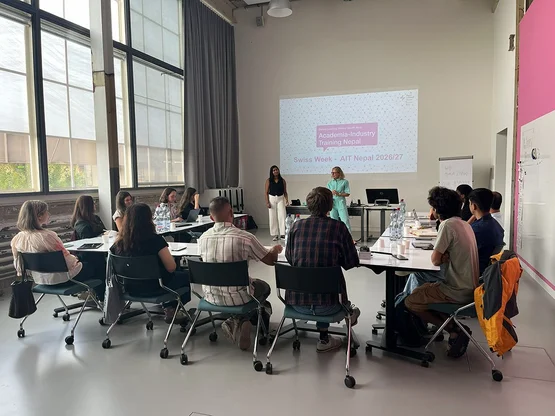
The Academia-Industry Training (AIT) programme empowers researchers from Switzerland, India and Nepal to turn their scientific discoveries into market-ready innovations. The programme provides the support needed to navigate the innovation ecosystems in Switzerland and India or Nepal, bringing promising solutions closer to market readiness.
Learn more about the Academia-Industry Training India
Learn more about the Academia-Industry Training Nepal
Indo-Swiss Quantum Dialogues
The Indo-Swiss Quantum Dialogues cerate space for genuine, in-depth dialogue across quantum research, innovation, policy and potential areas of application. The format prioritises open exchange, shared questions and conversations across disciplines. Learn more about the Indo-Swiss Quantum Dialogues
Connect & Collaborate Grant
The Connect & Collaborate Grant (CCG) supports Swiss-based researchers who are addressing the world’s most pressing challenges by sharing knowledge, exchanging findings, and establishing long-lasting ties. They do so through the organization of workshops, symposia, and teaching activities, among other things. Learn more about the Connect & Collaborate Grant

Eligibility
General Eligibility Criteria
The following eligibility criteria apply to funding instruments and programmes offered by the Swiss Leading House South Asia. Specific eligibility requirements, including career stage, institutional affiliation and other conditions, may vary depending on the instrument and are outlined in the respective calls for applications.
1. Eligible Swiss institutions
In accordance with Articles 4 and 5 of the Swiss Federal Act on the Promotion of Research and Innovation (RIPA), applicants from the following institutions are generally eligible for research funding through the Swiss Leading House South Asia.
A. Higher education institutions
Swiss higher education institutions accredited under the Federal Act on the Funding and Coordination of the Higher Education Sector (HEdA), including:
Cantonal universities, Universities of applied sciences, Universities of teacher education, Federal institutes of technology (ETH Zurich and EPFL).
An overview of accredited institutions is available through swissuniversities.
B. Research institutes within the ETH Domain
In addition to ETH Zurich and EPFL, the following institutions are eligible:
Paul Scherrer Institute (PSI), Swiss Federal Laboratories for Materials Science and Technology (Empa), Swiss Federal Institute for Forest, Snow and Landscape Research (WSL), Swiss Federal Institute of Aquatic Science and Technology (Eawag).
C. Research facilities of national importance
Research facilities of national importance recognised under Article 15 RIPA may be eligible, provided they meet the applicable research quality and institutional requirements.
D. Federal research institutions
Institutions of the Swiss Federal Administration conducting research or research-related activities as part of their statutory mandate may be eligible. Examples include Agroscope and MeteoSwiss.
E. Non-commercial research organisations
Non-commercial research organisations outside the higher education sector may be eligible provided that:
Their primary purpose includes conducting research. Their research meets quality standards comparable to those of higher education research institutions. Their owners or funding bodies do not derive financial profit from the research activities.
Examples of institutions previously assessed as eligible include the Research Institute of Organic Agriculture (FiBL) and the Centre de recherche sur l'environnement alpin (CREALP).
F. Other institutions
Institutions not covered by the categories above may be assessed on a case-by-case basis. Examples of institutions previously assessed as ineligible for Leading House research funding include CERN and other international organisations, CABI Delémont and swisstopo.
G. Eligible institutions in partner countries
Eligibility of institutions in partner countries is assessed by the Leading House, taking into account local conditions and institutional structures. Generally eligible are:
Accredited higher education institutions and public research institutions. Private or semi-private institutions may also be eligible if their research meets comparable quality standards and such institutional structures are common in the partner country.
Government ministries or departments conducting genuine research activities comparable to Ressortforschung (departmental research) in Switzerland.
2. Eligibility of researchers
For research collaboration grants, the following general requirements apply to principal investigators (PIs) in Switzerland and in the partner country:
Institutional affiliation: Applicants must be employed by an eligible research institution.
Position: Applicants must hold a permanent position or a position covering at least the duration of the proposed project, enabling them to carry out the proposed research activities and contribute meaningfully to the collaboration.
Qualifications: Principal investigators should generally hold a PhD or have at least three years of relevant research experience. Individual funding instruments may require higher qualifications or additional experience. PhD students may apply as main applicants provided they meet the applicable eligibility requirements.
Employment level: Applicants must generally hold a position corresponding to at least 40% full-time equivalent (FTE).
3. Participation of additional partners
Participants from other countries
Participants from countries outside the geographical scope of the Leading House South Asia may be involved in research projects where their participation provides clear added value.
Such participation must generally be self-funded. In exceptional cases, funding of up to 20% of the total grant may be considered, subject to the applicable funding conditions.
Participants without affiliation to an eligible institution
Researchers or other project contributors who are not affiliated with an eligible institution may be considered on a case-by-case basis.
Their eligibility to receive funding depends on their role, country of affiliation and the requirements of the respective instrument.
4. Instrument-specific requirements
The general criteria above provide the framework for eligibility across the Swiss Leading House South Asia's funding instruments and programmes.
Individual calls may establish additional or different requirements concerning:
Eligible countries and institutions, Career stage and professional qualifications, Minimum employment level and contractual status, Academic or non-academic affiliation, Thematic focus and project relevance, Eligibility of project partners and other participants.
Applicants should therefore consult the eligibility requirements published in the respective call before submitting an application.