Section of Functional Materials and Nanotechnology

«Teaching does much, but encouragement does everything.»
- Johann Wolfgang von Goethe -
Prof. Dr. Christian Adlhart Head of Section Functional Materials and Nanotechnology
The Functional Materials and Nanotechnology Research Group focuses its research and development on applications where materials are used at interfaces. For us, the research focus on “Smart Materials” means developing fibers that selectively deliver drugs or perform specific functions, such as removing chromium from wastewater. We achieve this through customized functionalization of their surfaces. We produce our nanofibers via electrospinning in the laboratory and on a pilot scale. “Smart Materials” also involves the search for biomaterials to replace existing substances or the synthesis of fibers that capture CO₂ from the air.
Another focus area is adsorption materials for per- and polyfluorinated alkyl substances (PFAS): We characterize their adsorption performance, model their behavior, and develop materials for the targeted removal of PFAS from water. We have a wide range of microscopic and spectroscopic techniques at our disposal for their characterization and functional testing. For fluorine-related analysis, our focus is on combustion ion chromatography (CIC).
Competencies and research
Opportunities for collaboration are available within the framework of research and development projects, service contracts, or bachelor’s and master’s theses in the following areas:
Functional- and biomaterials as well as nanotechnology

- Development of nanofiber-based membranes for filtration purposes
- Development of nanofiber-based highly porous sponges for tissue engineering
- Encapsulation and controlled release of active ingredients using nanofibers
- Development of nanofibers from biomaterials such as carbohydrates, chitosan, or proteins
- Stabilization of molecules through encapsulation in nanoporous materials
- Development of new column materials for chromatography
PFAS adsorption materials and analytics
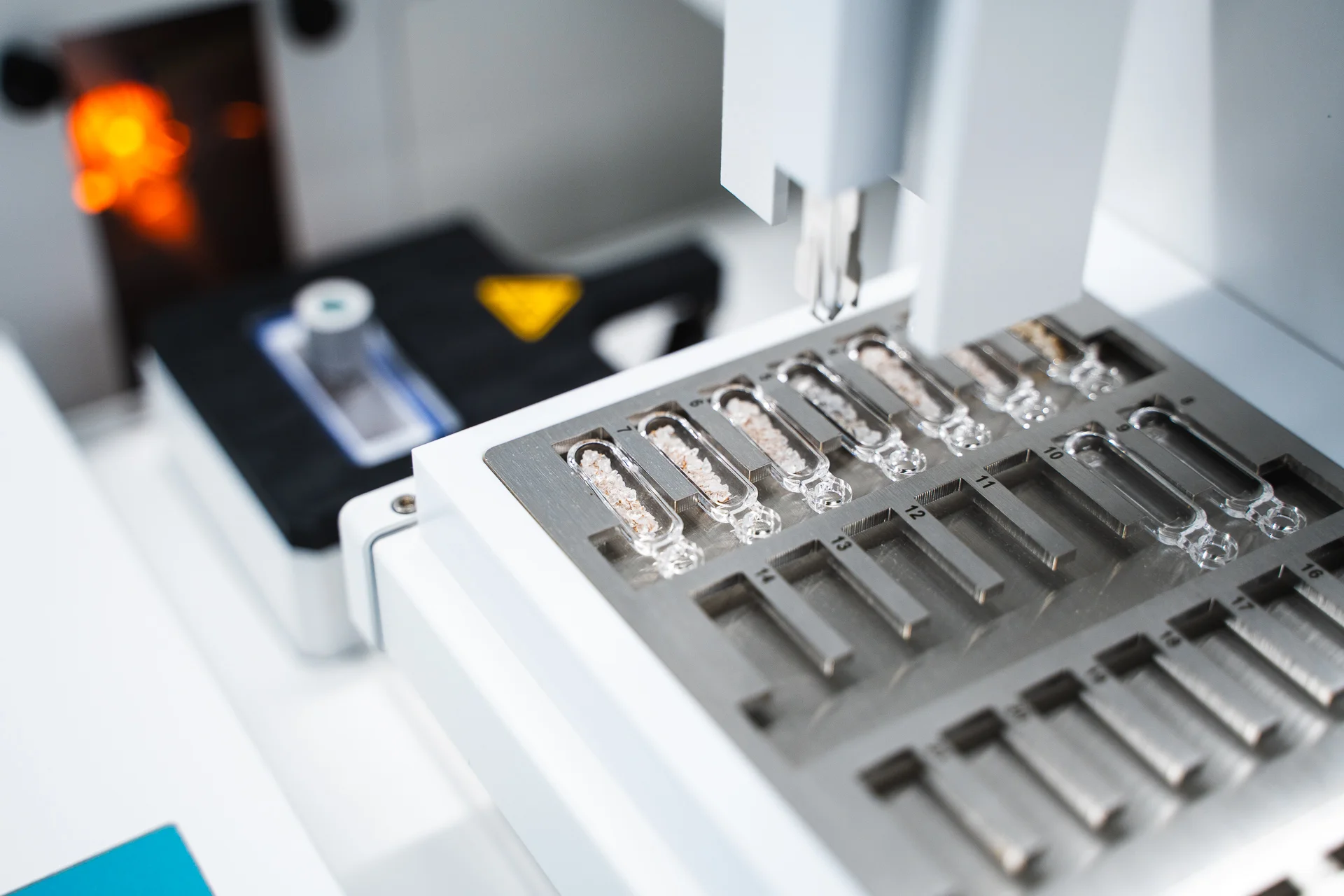
- Characterization and development of adsorption materials for the removal of PFAS from water
- Modeling of adsorption isotherms and breakthrough curves to evaluate material behavior in filtration applications
- Analytical focus on combustion ion chromatography (CIC): Determination of total fluorine parameters such as total fluorine (TF), total organically bound fluorine (TOF), and adsorbable organically bound fluorine (AOF)
- Investigation of total fluorine parameters in various matrices such as water, soil, sludge, and manure
- Supplementary PFAS target analysis using LC-MS/MS to determine selected individual compounds
Surface analysis

- Analysis and evaluation of surfaces using scanning electron microscopy (SEM)
- Analysis of surfaces using confocal Raman microscopy
- Measurement of surface charge (zeta potential) of powders, fibers, membranes, and tissues using streaming potential measurements
- In vivo/in vitro studies on the skin penetration of active ingredients
Filtration technology

- Consulting on the selection of suitable filtration systems and filter aids
- Systematic investigation and selection of filter aids
- Development of depth filter layers—use of novel fibers and/or inorganic materials
- Customized filtration products for the targeted removal of “impurities”
- Services for optimizing industrial filtration processes
Specialized techniques

- Combustion ion chromatography (CIC) for total fluorine parameters
- LC-MS/MS for complementary PFAS target analysis
- Field-emission scanning electron microscopy (SEM) with EDX
- Confocal Raman microscopy (532, 671, 785 nm)
- Fluorescence-free Raman spectroscopy
- Multiphoton microscopy
- In vivo Raman microscopy (RiverD Model 3510 Skin Composition Analyzer)
- Zeta potential measurement
- BET surface area measurement
- Pore size analysis
- Particle size determination (DLS and NTA)
- Dynamic contact angle measurement
- Electrospinning equipment on an industrial scale
- Laboratory filtration systems (depth filtration and microfiltration)

- Pore size analysis
- Particle size determination (DLS and NTA)
- Dynamic contact angle measurement
- Electrospinning equipment on at pilot scale
- Laboratory filtration equipment (depth filtration and microfiltration)
Publications
-
Eibl, Dieter; Sievers, Martin; Eibl, Regine; Bachmann, Martin; Walton, Senta; Keel, Nik; Richner, Gilles; Stübinger, Stefan; Hirsch, Sven; Yeretzian, Chahan; Opitz, Sebastian E.W.; Heldal, Trond; Adlhart, Christian,
2021.
Keeping SARS-CoV-2 out : vaccines, filters, and self-disinfecting textiles.
Chimia.
75(3), pp. 215-218.
Available from: https://doi.org/10.21256/zhaw-22201
-
Kaegi, Martin; Adlhart, Christian; Lehmann, Markus; Risch, Marius; Wessling, Werner; Klaffenbach, Peter,
2020.
A novel microfiber wipe for delivery of active substances to human skin : clinical proof of concept.
Polymers.
12(11), pp. 2715.
Available from: https://doi.org/10.21256/zhaw-20851
-
Kang, Chengjun; Honciuc, Andrei,
2019.
Versatile triblock Janus nanoparticles : synthesis and self-assembly.
Chemistry of Materials.
31(5), pp. 1688-1695.
-
Weidenbacher, Lukas; Müller, Eike; Guex, Anne Géraldine; Zündel, Manuel; Schweizer, Peter; Marina, Vita; Adlhart, Christian; Vejsadová, Lucie; Pauer, Robin; Spiecker, Erdmann; Maniura-Weber, Katharina; Ferguson, Stephen J.; Rossi, René M.; Rottmar, Markus; Fortunato, Giuseppino,
2019.
ACS Applied Materials & Interfaces.
-
Brodard, Pierre; Dabros, Michal; Marti, Roger; Vanoli, Ennio; Zinn, Manfred; Frey, Urban; Adlhart, Christian; Kind, Lucy; Koch, Franziska; Burgio, Floriana; Stenqvist, Johan; Saxer, Sina; Pieles, Uwe; Shahgaldian, Patrick; Wendeborn, Sebastian,
2019.
Materials science at Swiss universities of applied sciences.
Chimia.
73(7-8), pp. 645-655.
Available from: https://doi.org/10.21256/zhaw-17982
News
Mit effizienter Diagnostik Leben retten (Transfer Spezial 1/2025), Seite 4
Integrated Bio-based Materials Value Chains(PDF 477,7 KB) (Transfer Special 2/2022)
Processing biopolymers into 3D nanofiber sponges(PDF 85,7 KB) (Transfer Special 2/2022)
Filtrieren nach dem Austern-Prinzip(PDF 3,9 MB) (Transfer 2-2021)
Auf der Suche nach dem perfekten Atemfilter(PDF 356,2 KB) (Transfer 1/2020, German)
Wie eine digitale Plattform aus Abfällen Ressourcen macht(PDF 207,8 KB) (Auszug Impact 3817)
Dem Menschen in die Haut geschaut(PDF 104,9 KB) (Transfer 2/2011, German)