Excel Tool for the Design of Ammonia Refrigeration and Heating Machines
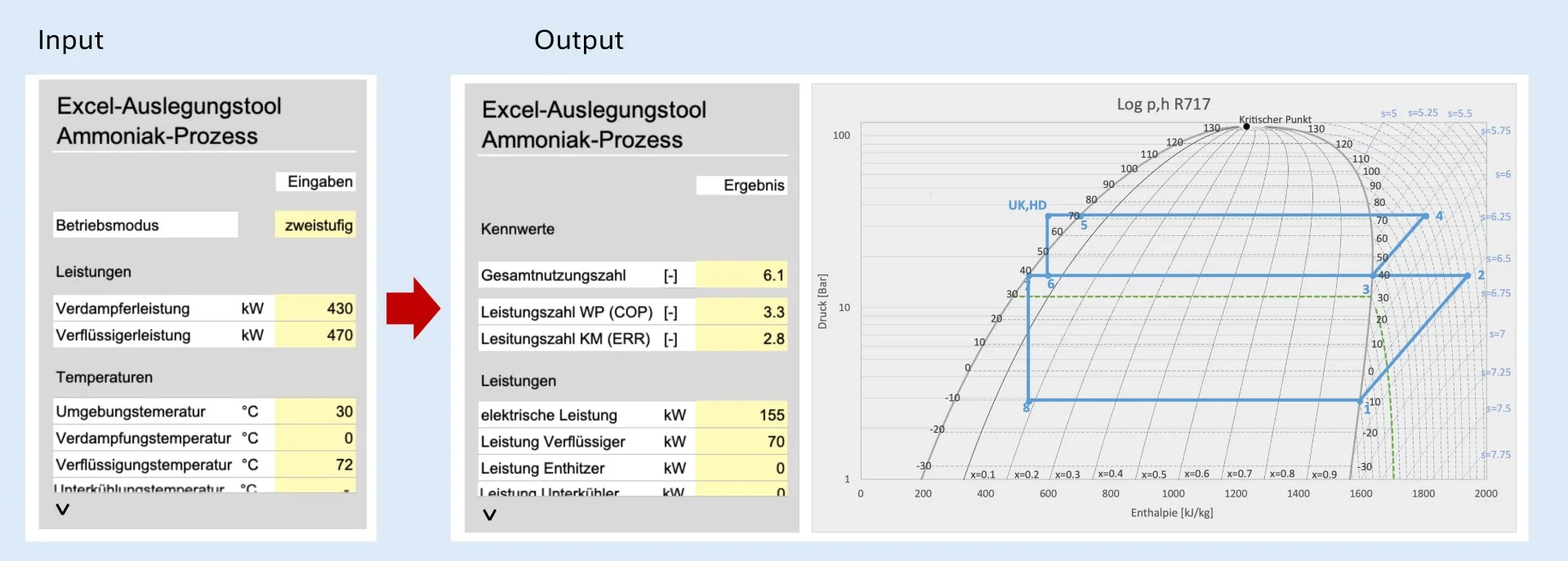
How does an ammonia plant perform under different operating conditions? A new Excel tool provides the answer. With just a few inputs, you can model single- and two-stage ammonia processes, calculate thermodynamic parameters, and perform optimizations based on mass and energy balances.
Ammonia (NH3) is a natural and extremely energy-efficient refrigerant. It is climate-friendly and has no ozone-depleting potential. Today, NH3 systems are primarily used in industrial refrigeration, district heating and cooling, and artificial ice rinks. Ammonia is typically used in larger refrigeration systems. Currently, systems with cooling capacities of up to 30 MW are being implemented in Switzerland; studies are already examining systems with capacities of up to 130 MW.
At this scale, it is worthwhile to carefully design the systems during the planning phase and analyze their operational behavior. By modeling and evaluating various steady-state operating conditions, the systems and their components can be specifically optimized and made more energy-efficient. To perform these analyses efficiently, a calculation tool was developed in Excel in collaboration with Coex Kälteplanung AG.
The ZHAW School of Engineering is home to the Institute for Energy Systems and Fluid Engineering (IEFE), Switzerland’s leading research group in refrigeration technology. IEFE researchers have many years of experience in developing Excel-based calculation tools for analyzing thermodynamic cycles. The institute previously developed a design tool for single-stage refrigeration processes using a wide variety of refrigerants. In addition, another tool was created for calculating two-stage CO₂ refrigeration processes.
As part of the project, the IEFE adapted the concept of the two-stage CO₂ refrigeration process to the two-stage ammonia process. Using the ammonia tool, various operating conditions of an ammonia plant can be visualized and analyzed with just a few inputs—such as the evaporation and condensation temperatures.
The tool has a modular design and can be expanded as needed to include additional components such as deheaters or subcoolers. This makes it suitable for both modeling simple refrigeration cycles and designing more complex system configurations.
As a result, the Excel design tool provides a graphical representation of the two-stage ammonia process on a log p,h diagram, as well as a complete mass balance. This gives the engineers at Coex Kälteplanung AG exactly the information they need to evaluate steady-state operating conditions and optimize ammonia systems in a targeted manner.
Project Name
Design Tool for Process Modeling and Performance Analysis of Ammonia Plants
Client
Coex Kälteplanung AG, Matthias Brügger
Participants
Projektleitung: Milena Zurbrügg, ZHAW
Projektmitarbeitende: Zoe Abeln, ZHAW, Frank Tillenkamp, ZHAW, Niels van Meurs, ZHAW
Project duration
December 2025 to June 2026