Keynote at the World Quantum Computing & Engineering Summit
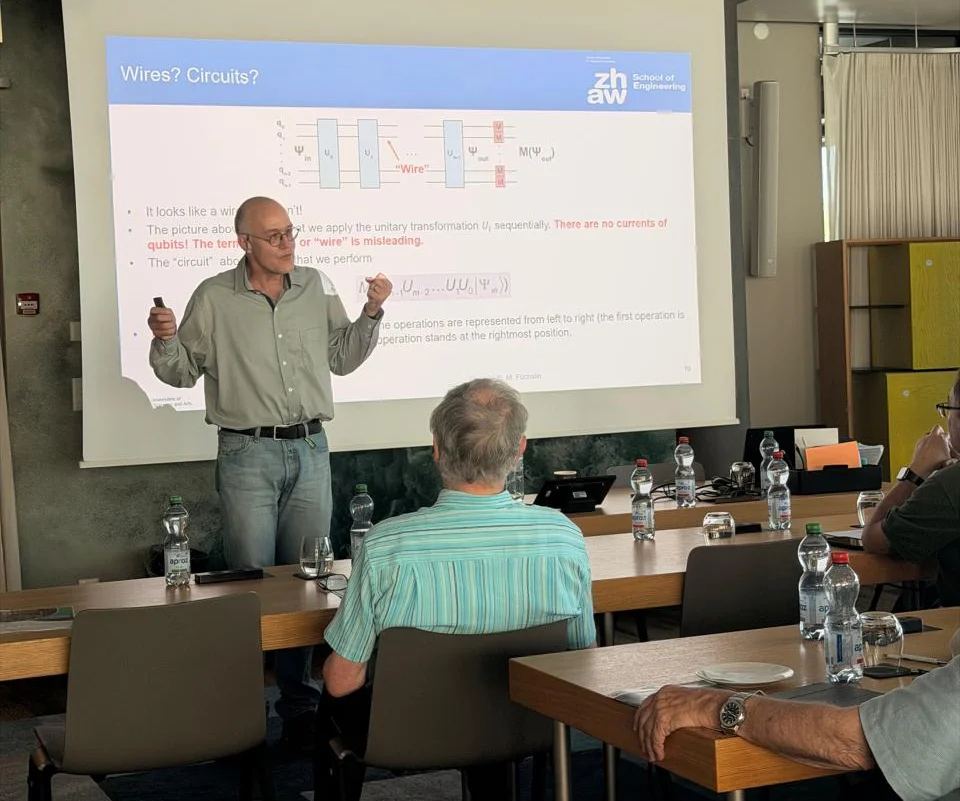
Prof. Dr Rudolf M. Füchslin from the Quantum Lab delivered a keynote at the World Quantum Computing & Engineering Summit (WQCES 2026) in Bern. His talk was entitled “Quantum Machine Learning: Surprising Efficiency in Real Applications”.
The keynote provided an overview of current approaches to quantum machine learning, with a particular focus on circuit-based models and their industrial relevance. It contrasted the conventional, algorithm-oriented paradigm of gate-based quantum computing with parameterised quantum circuits, in which expressivity, trainability and hardware constraints take centre stage.
The talk reviewed several approaches to quantum machine learning, including quantum-enhanced feature maps, variational classifiers and regressors, quantum kernel methods and hybrid quantum–classical learning architectures. It also presented applications that already extend beyond simple proof-of-concept examples in both scale and practical relevance, including quantum machine learning for entity matching and spectral data analysis.
A central theme was a recently observed improvement that does not fit the usual narrative of quantum speed-up: more stable and faster model convergence.
The work is driven by a clear ambition to strengthen the connection between academia and industry, based on the conviction that theory reaches its full potential only when tested against the complexities of real-world problems.