“Hack the Quantum” at Nacht der Technik 2026
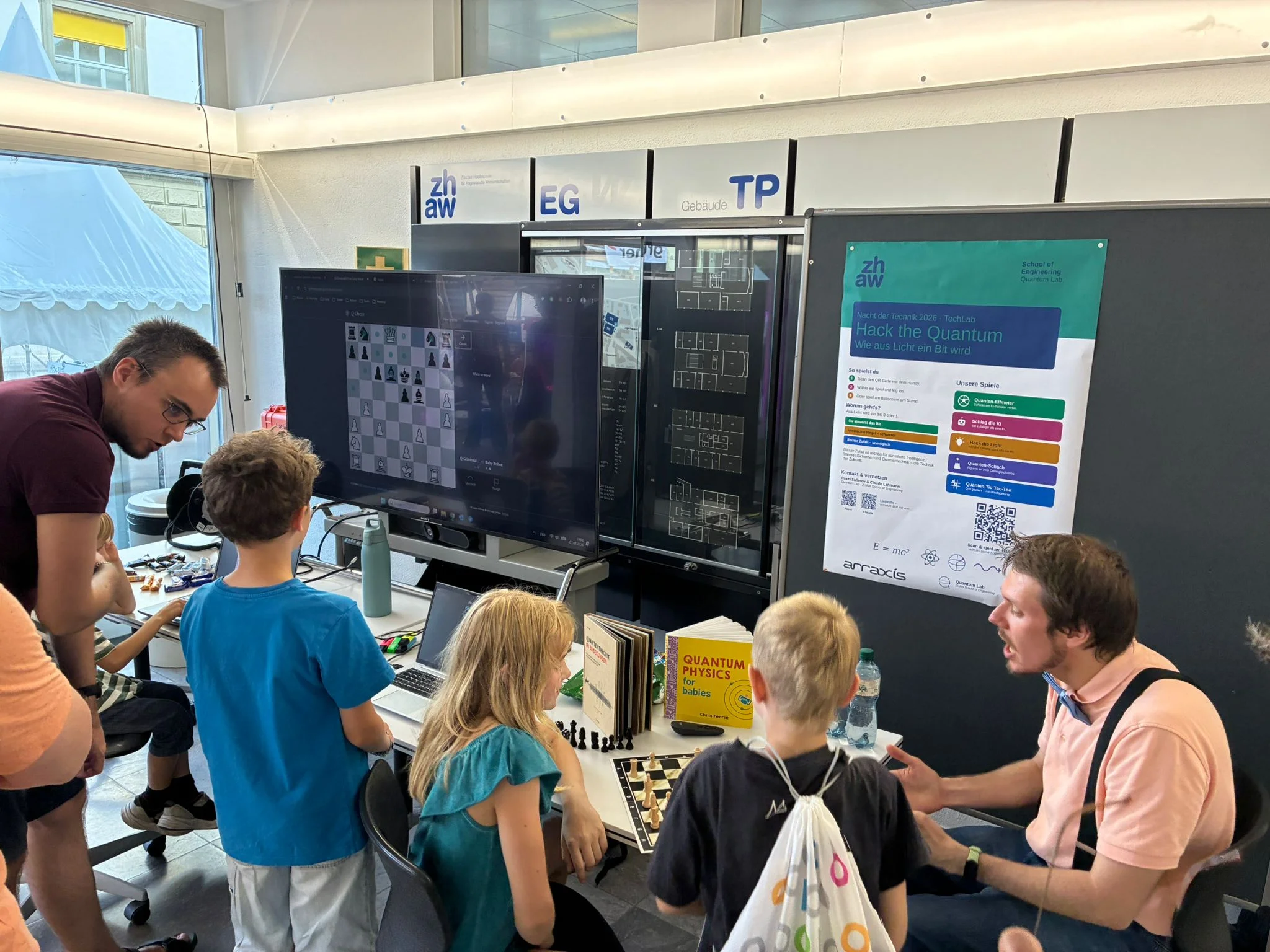
At Nacht der Technik 2026, organised by the ZHAW School of Engineering, the Quantum Lab teamed up with Arraxis to bring “Hack the Quantum” to the TechLab. The stand was designed for curious children aged six and above, as well as their parents. Claude Lehmann and Dr Pavel Sulimov represented the Quantum Lab and guided visitors through the activities.
The aim was not to teach primary-school children the theory behind superposition, entanglement and qubits. Instead, the activities allowed them to experience quantum ideas through play and have fun in the process.
Five hands-on games brought abstract concepts to life. Loaded dice and “true randomness” demonstrated that some events simply cannot be controlled – the same principle that helps to protect passwords. A shared reading of Quantum Physics for Babies provided a surprisingly accessible introduction to wave–particle duality.
In the “Super Quantum Shot” penalty game, the ball travelled towards two corners at once until the goalkeeper’s measurement determined where it had landed. A chaotic round of quantum chess saw one young player create eight queens through superposition. Another activity used a camera to turn light into bits, while a challenge to produce more random results than an AI offered a playful introduction to the importance of randomness in artificial intelligence and security.
A live leaderboard, a genuinely random “quantum draw” awarding sweets and a room full of hands-on experiments left many children and parents curious to learn more about the fascinating world of quantum physics.
The games, co-designed with Sergey Eremeykin, are available to try online.
Try the games: arraxis.com/nachtdertechnik/